
„Over the next decades, the Ignalina NPP's reactors will be dismantled, the buildings demolished, and the environment will be cleaned up beyond recognition. Therefore, people are attracted to take advantage of the historic opportunity to see everything with their own eyes while the opportunity is still available,“ says Milda Kiškytė, Ignalina NPP Communications Specialist and Tour Manager.
The power plant received 100,000 visitors
On average, Ignalina NPP receives 3.5 thousand visitors every year. A record number of almost 5,000 visitors was received in 2019. That year, the HBO series „Chernobyl“, filmed in Lithuania and on the territory of the Ignalina NPP, was released, which was very popular around the world and brought an additional flow of tourists.
Since 1995, when the Ignalina NPP Information Centre opened its doors, the plant has welcomed about 100,000 visitors in total.
According to Ms Kiškytė, the largest number of tourists are residents of our country, while about one-third of all visitors come from various countries around the world. Most of them are Europeans, but there are also many visitors from distant lands such as Japan, the Americas and Australia.
„One of our corporate goals is openness to the public and transparency of information. It is important for us to educate the audience, who are interested in learning about the history of the plant, its decommissioning, its current activities, and how radioactive waste is managed,“ notes Kiškytė.
What are visitors most interested in?
Visitors ask many questions during the almost three-hour tour of the Ignalina NPP-controlled area. Usually, they are interested in the history of the plant and the circumstances of its closure. Summing up all the questions, they can be divided into three main areas that arouse the greatest interest of visitors, notes M. Kiškytė.
„Firstly, there are the environmental and human safety issues: whether it is safe to visit the site, and what the risk to the environment might be from radiation. Secondly, what are the current activities of the closed power plant, and what do the employees do. Thirdly, what will happen to the radioactive waste, and how will it be managed,“ she says.
She adds that visitors are surprised to learn that background radiation around the Ignalina NPP site is currently lower than in our country's major cities. „This is usually where we start the tour – visitors are left with most of the safety-related questions so that they can concentrate on other matters of interest and the nuclear power plant facilities,“ says Kiškytė.
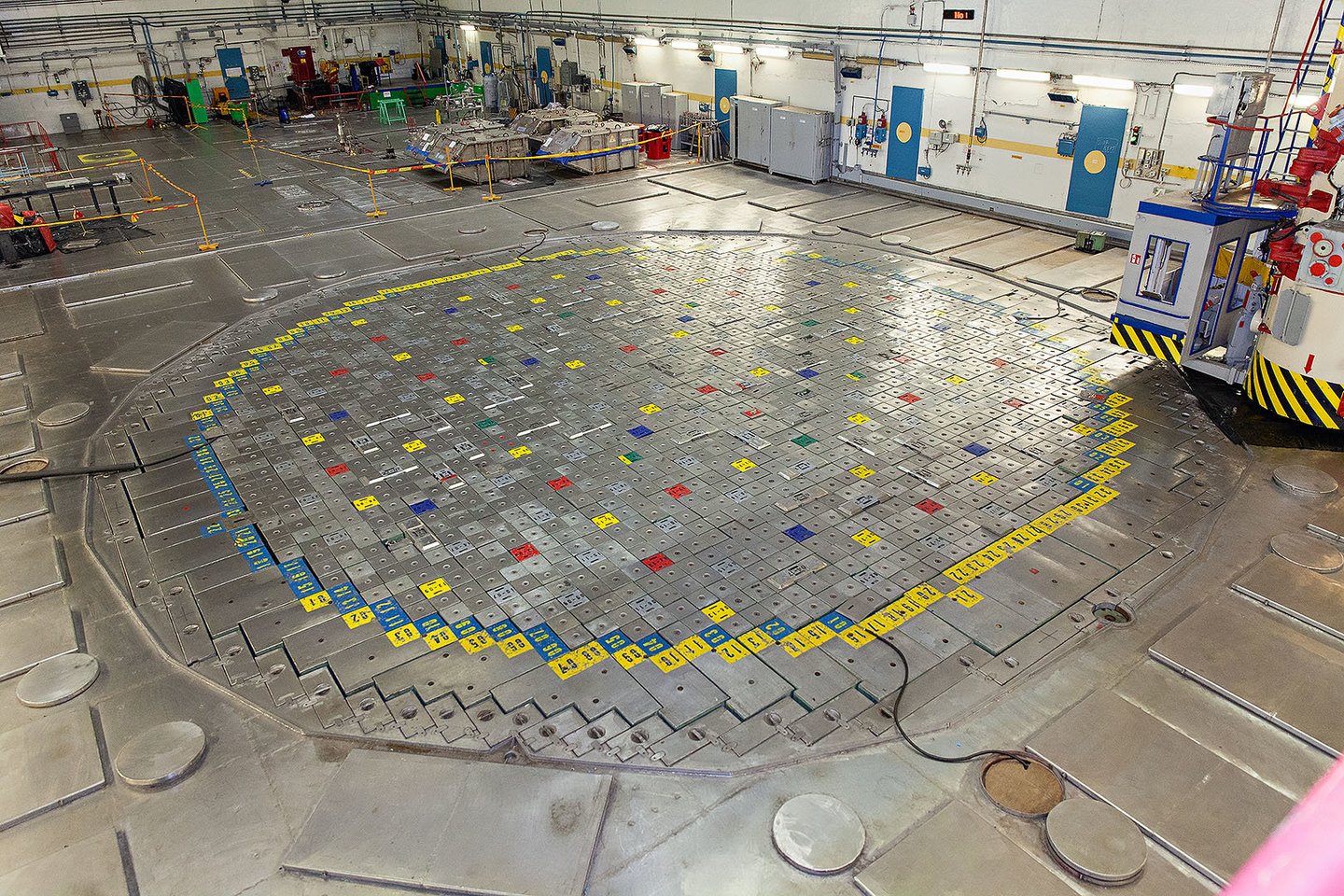
During the guided tours in the controlled area of Ignalina NPP, visitors have a unique opportunity to visit three main areas: the nuclear reactor hall, the turbine hall, which has already been dismantled, and the reactor control room.
The main attraction is to stand on the reactor
The most impressive part of the tour is the huge reactor hall, where visitors can stand on a nuclear reactor. Two reactors were installed at Ignalina NPP out of a planned four. Each reactor had a capacity of 1500 megawatts. During the plant's lifetime, the reactors were the largest and most powerful of any RBMK-type reactors in the world.
„Visitors are interested to know how much nuclear fuel was in each reactor, how fast and often it burned out and how the fuel assemblies were replaced, how the spent fuel was moved from the units to the interim fuel storage facility, and what will happen to the long-lived waste in the future,“ says Kiškytė.
Currently, there is no more spent nuclear fuel in both reactors. After both Ignalina NPP reactors were shut down – the first in 2004 and the second in 2009 – the spent fuel was unloaded and placed in two temporary spent fuel storage facilities on the site. The last spent fuel container was placed in storage in spring 2022.
How is radioactive waste managed?
One of the most frequently asked questions during the tours is how is radioactive waste managed and how long will it remain hazardous?
Spent nuclear fuel is the most hazardous of all radioactive waste. It contains as much as 99 per cent of the total amount of radionuclides produced in a nuclear reactor. It takes several hundred thousand years for spent nuclear fuel to become non-hazardous.
The plan to store spent fuel in the interim storage facility for at least 50 years is a temporary solution. The design lifetime of the containers and repositories means that long-lived radioactive waste that will remain hazardous to the environment for thousands of years will be stored there for several decades. At the end of the lifetime of the casks and storage facilities, preparations must be made for the final disposal of the long-lived radioactive waste by transferring it to a deep geological repository.
Deep geological repository is a special-purpose civil engineering structure installed in the ground. Only seismically and tectonically stable areas with suitable geological formations at a 200–700 metres depth shall be selected for its installation. It should be noted that there is a wide variety of rock formations, but not all of them are suitable for a deep geological repository. Only those geological formations that have changed little over millions of years, whose properties can be reliably assessed and are likely to remain stable over the next million years, are selected.
In Lithuania, a deep repository is planned to be built and operational in 2068.
No other alternatives
Tour participants are interested to know whether there are other alternatives, such as recycling or taking radioactive waste abroad for storage.
As an EU country, Lithuania has made a commitment to treat all existing and future radioactive waste and spent nuclear fuel in the country. At the same time, the country has committed itself to avoid placing any unreasonable burden on future generations related to the treatment of radioactive waste.
Lithuanian law prohibits the reprocessing of spent nuclear fuel within the country. Spent fuel can be reprocessed in foreign countries, but the resulting secondary waste would be returned to Lithuania. In the current circumstances, reprocessing of nuclear fuel to produce reusable fissile materials is not feasible, as the possibility of using these materials is very limited, and the secondary long-lived high-level waste produced must be managed in a similar way to unreprocessed spent nuclear fuel.
It should be noted that Lithuania, like other foreign countries, prohibits the importation of radioactive waste from other countries into its territory. Therefore, the final management of long-lived radioactive waste present and to be generated in our country must be carried out in Lithuania.
Given the existing technology, the only sustainable, safe and realistic final disposal option for long-lived radioactive waste at present is to place it in a deep geological repository.
Following the global nuclear community, examples of radioactive waste management in other countries, and the recommendations of the International Atomic Energy Agency (IAEA), Lithuania has enshrined in its legislation that the only possible final disposal option for spent fuel and high-level radioactive waste is to place it in a deep geological repository.
Challenges for the future
The most complex technological challenge ahead is the dismantling of the two RBMK-type nuclear reactors, which have never been dismantled before. It is important to note that the decommissioning of the Ignalina NPP is a one-of-a-kind process, as no reactor of this type has been dismantled anywhere in the world.
„Lithuania is the first country in the world to prepare for the dismantling of RBMK-type reactors after the discharge of spent nuclear fuel. Openness and public information about ongoing and planned work is an important part of this process. Guided tours of the controlled area and the opportunity to see with their own eyes what things look like, what work is being carried out and what work will be carried out in the future help the public to understand the scale of the work being carried out, its significance and its responsibilities. Our aim is to create a clean environment by managing the legacy of nuclear activities in a sustainable way so that future generations do not inherit this burden,“ notes the Communications Officer.
Dismantling of the first reactor is scheduled to start in 2028, and the second reactor in 2029. Only after the completion of the dismantling of the reactors will it be possible to carry out the demolition of the last buildings and infrastructure of the Ignalina NPP.
„We want to keep the tours as long as possible so that as many people as possible get to know our activities. Access to certain areas of the Ignalina NPP will be restricted in the future as part of the decommissioning work, but we are already preparing for this and planning what unseen areas we can show to visitors. There will be enough secrets and curiosities at the Ignalina Nuclear Power Plant for a long time to come,“ says M. Kiškytė.