
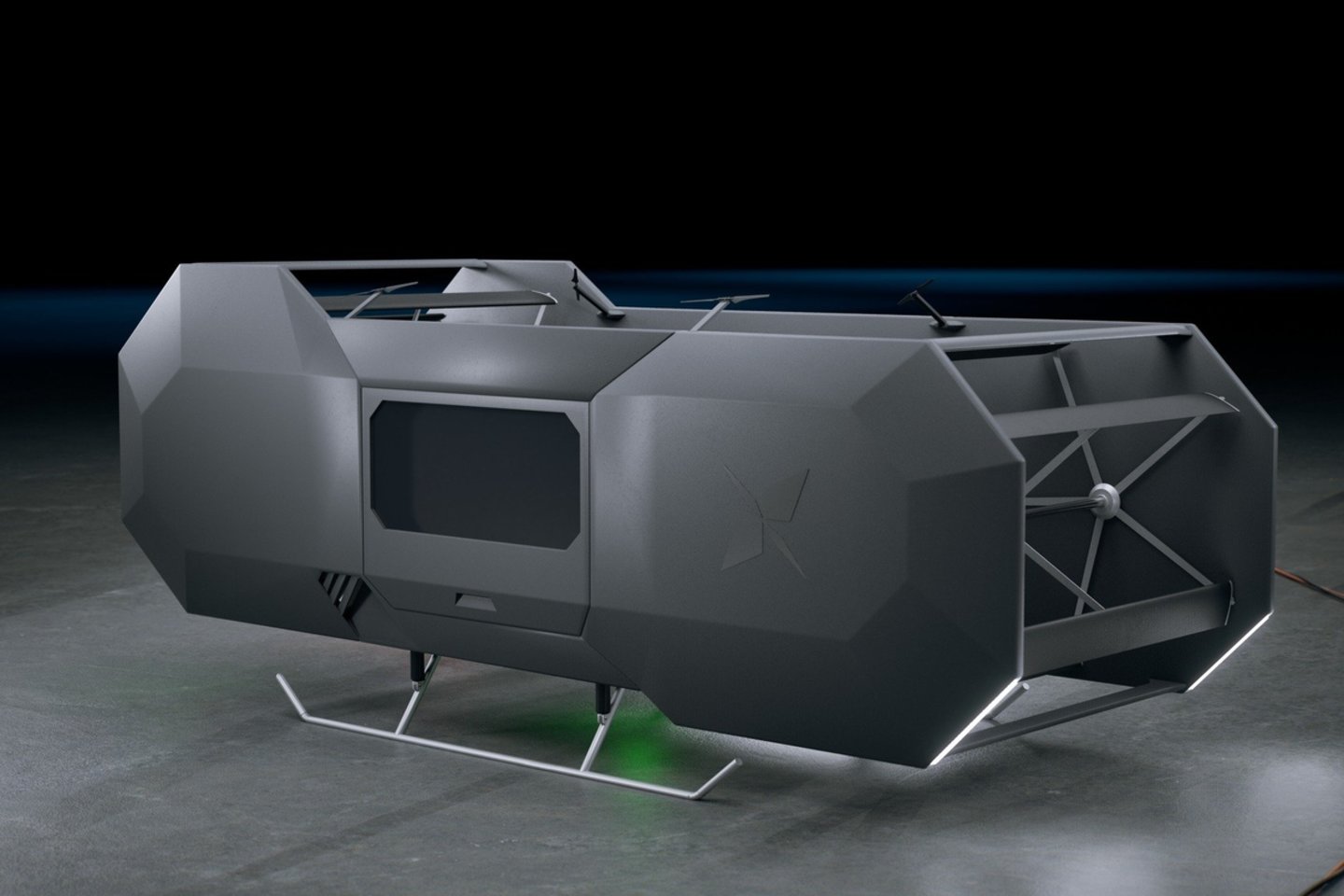
Unlike traditional propellers, this horizontal axis rotor has five blades that rotate around a horizontal axis. Their entire working surface moves at the same speed, allowing the design to optimise aerodynamic performance with high precision and minimise energy losses. Tests have shown that the Lithuanian-designed rotor consumes up to 50% less energy at maximum thrust than any other rotor on the market to date.
„Our team's innovative solution allows us to maintain high efficiency and extremely low noise levels. Quiet operation is critical for urban mobility, as noise is one of the limiting factors for flight. Despite its quiet operation, a single rotor can generate up to 250 kilograms of lift. Two rotors are equivalent to an 8-metre diameter helicopter propeller, but take up much less space,“ says Tomas Narbuntas, Chief Technology Officer at Airvolve.
Achieving what Boeing's founder failed to do
80 years ago, William Boeing, the founder of Boeing, first proposed the idea of a horizontal axis rotor. But he could not make it happen – the technology did not exist at the time to make blades that were both light enough and able to withstand the enormous centrifugal loads generated by the rotor's rotation.
„We had to develop something that did not exist on the market – a new technology for treating metal surfaces. It took six months of constant trial and error, but in the end we succeeded. We
have created unique blades that can withstand loads of up to 1,000 times their own weight,“ says Narbuntas.
Unique battery
According to the company's Chief Technology Officer, Airvolve bought two Tesla electric car batteries, took them apart, examined each component and developed its own solution to fit the aircraft rotor system. Today, the company has the world's first battery of its kind designed specifically for aviation, with exceptional power density.
The rotor is an important part of an exceptional aircraft
Airvolve is developing a tactical utility aircraft that has 10 times lower operating costs than conventional helicopters. The company's exclusive horizontal axis propulsion technology will enable the transport of high volume and weight loads over distances of up to 150 km. The aircraft itself fits into a sea container, making it particularly convenient for transport and storage.
We envisage such an aircraft being used for a wide range of civil and defence missions, such as autonomous cargo delivery, casualty evacuation and search and rescue.
The first Airvolve prototype was tested in May 2024, completing two years of pilot testing. The full-size aircraft is now being assembled and test flights will begin in June this year in Lithuania.
In early 2025, the company filed an initial patent application with the United States Patent and Trademark Office (USPTO), which will give the company 12 months to finalise the patenting of the invention. Airvolve's patent will protect the development of an aircraft with horizontal axis rotors and a lift generating body.
Video how the rotors work
https://youtu.be/8BIeKEk-JjY?si=QAkWLVNb3z-neQI