
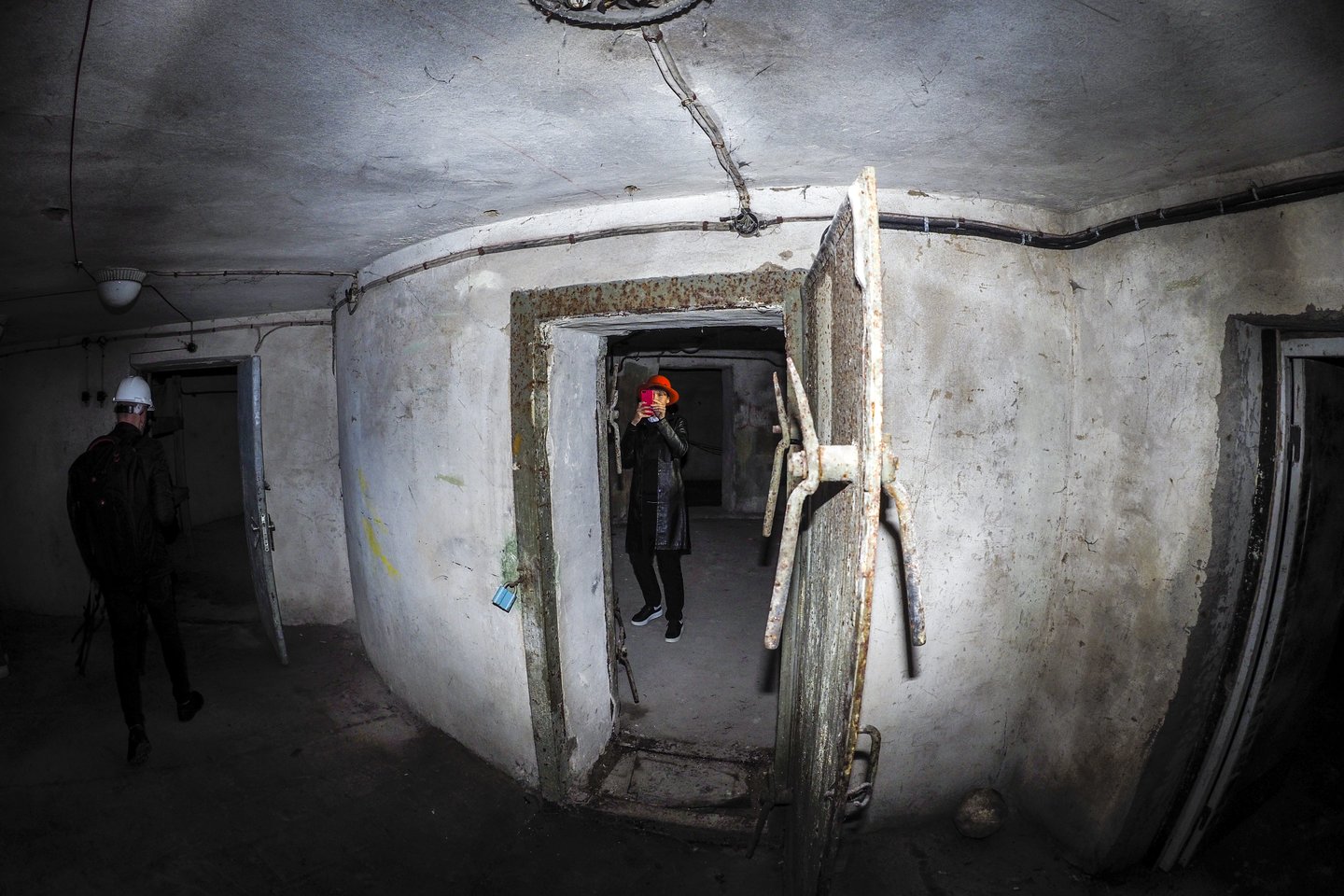
A hiding place for tens of thousands of euros
According to the Fire and Rescue Department, there are 1 913 collective shelters in municipalities, providing space for around 1.2 million (44%) of the country's population.
On Tuesday, at a press conference at the Government, Minister Agnė Bilotaitė said that the country pays sufficient attention to civil protection. Still, she did not say how many suitable shelters are currently available in Lithuania.
Several Soviet-era shelters for sale can be found on real estate portals: a contact with real estate brokers who sell them revealed that one shelter in Kaunas. With an area of almost 100 sqm, it has already been sold, and there was interest in using it for storage even before the Ukraine conflict.
Another shelter is for sale in Kaunas on Kalantos Street for 11,000 euros. According to the real estate broker who is selling it, this is the first time in 12 years of work that such an object has been sold. And the interest in it has been higher than usual in the last couple of weeks.
When contacted, the man selling the shelter in A. Juozapavičiaus Avenue in Kaunas for EUR 13,500 said that he had received only one call from an interested person in the last few days. However, he did not say he was looking for such property for what purpose.
According to the Kaunas man selling a hideout in the basement of a 1956-built apartment building, similar hideouts were popular in the past for escape rooms. Before the sale, the premises, which have an area of almost 100 sqm, were empty. When asked if he had thought of keeping the hideout for himself, he didn't hesitate - "no". He does not believe it would help in the event of war.
One shelter is currently for sale in Vilnius for EUR 85 000.
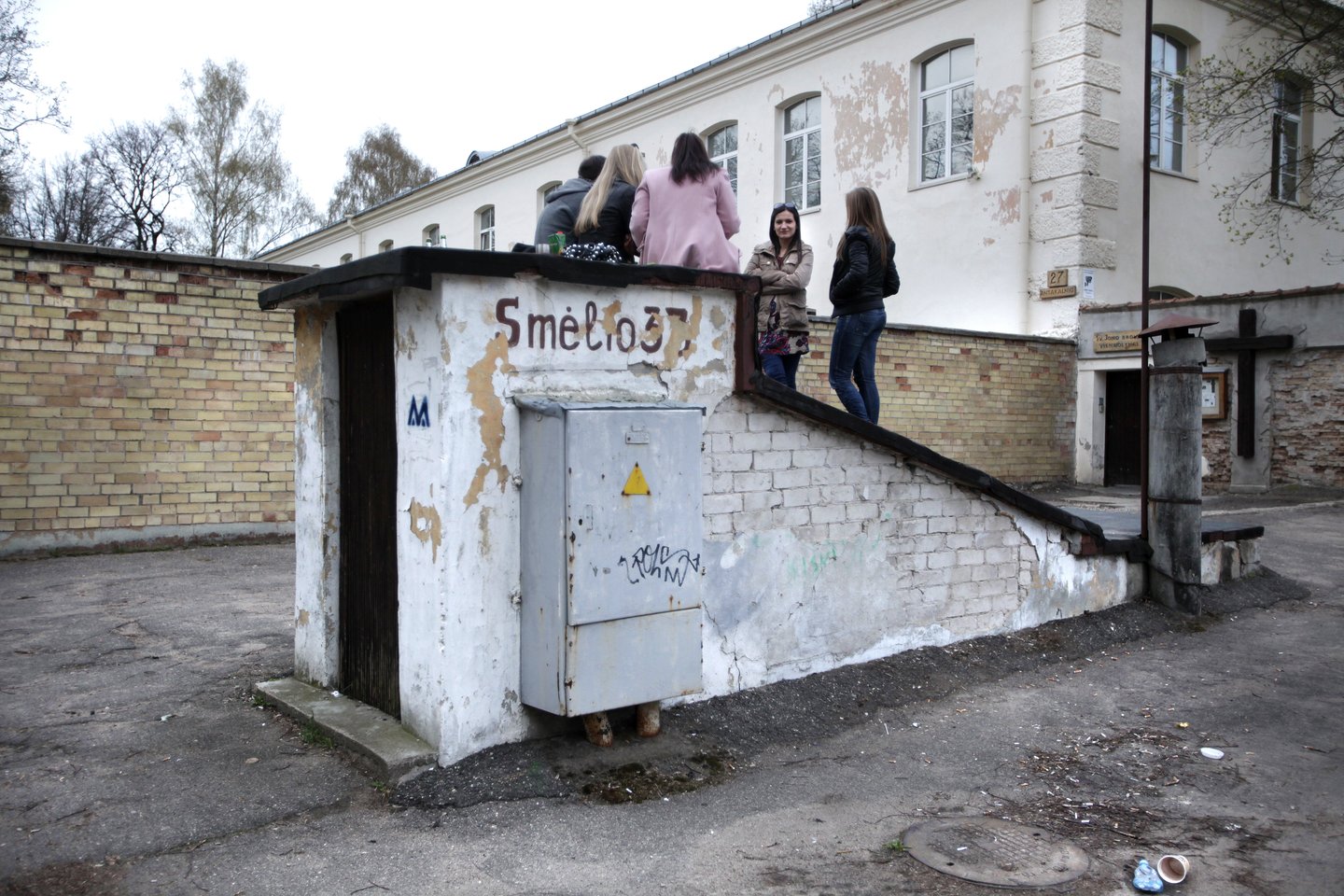
When asked how many and what kind of reinforced concrete structures we have in Vilnius from the Soviet era to protect us in case of weather danger of war, and what the shelters have become today, Albertas Kazlauskas, the founder of Gatvės gyvvos, recalled the various transformations they have undergone: Some shelters have been converted into storage rooms, converted into living quarters - apartments without windows, for example, in the Old Town; there are shelters adapted for nightclubs, bars, bowling clubs. Kazlauskas has also seen a dog-training ground set up in a hideout and sports clubs operating in them - it all depends on the owner's imagination.
According to Mr Kazlauskas, most of them are located close to the city centre or in industrial areas, next to factories, as far as former shelters are concerned. Only at the end of the Soviet era did more shelters begin to be built in residential areas. It was important to be able to hide immediately if necessary, and factories were one of the main places of work, so there were many shelters in the vicinity.
V.Balkūno nuotr.
The hideout in Antakalnis, where the nightclub Bombiakas was located, probably attracts the most attention in Vilnius because it is a really interesting place: it is close to a school, a church, a monastery, and the club was used for various parties. Another nightclub that has been operating in a bunker since 2000 is the Vault, which its new owners recently demolished.
According to the interviewee, there were several types of shelters: some were separate engineering structures, others were part of a building. The function of the nearly three hundred shelters in the capital was to protect in the event of hostilities. Although they were connected to buildings, they have well insulated: the rooms were airtight, the doors were airtight, the shelter was supplied with fresh air, food supplies were stored - everything needed to survive for a few days.
The shelter he and his wife bought was in good condition, and the company that owned it kept the shelter as it had been in the Soviet era, with only the need to dig it out and bring in electricity. Some of the heavy equipment - doors, ventilation equipment, sleeping racks - was still there.
According to Kazlauskas, there were shelters in many other towns, not only in the big cities, and not just one. There were several hundred in the capital, and many in Panevėžys and Alytus. However, these shelters are not in use, and they are practically all privatised in Vilnius. In Panevėžys or Alytus, we would likely find an entire industrial complex abandoned, where the shelter has not been used for thirty years.
Few people know that the bar on Goštauto Street was set up in a former shelter, although there are no signs of this.
The architects raised an important question
With the war in Ukraine, people take shelter in shelters when the sirens sound. In Lithuania, the question of where Lithuanians would hide if necessary was raised. Architect Tumas Mazūras, a member of the Council of the Lithuanian Chamber of Architects, posted a commentary on the LAR website inviting the discussion.
"What do we have today? Does anyone know where the nearest hiding place is? If someone knows - is it known to their family members?" - wrote the architect.
Indeed, there are websites dedicated to civil protection, videos, interactive maps showing collective protection structures, leaflets. Collective security buildings are mostly above-ground, and there are even pictures of people being housed in gyms.
"There are also articles about shelters in public institutions - maybe they are there, but if you check the map of shelters in Vilnius, all the objects look more like a list of educational institutions in the city than a map of shelters. There are indeed two basements (17 T. Shevchenko's Street and 6 Vokiečių Street) and an underground car park. However, the shelters in government offices mentioned on the page are simply not shown on the interactive map, so the question is whether citizens will be able to hide there. I do not pretend to know the size of the several basements shown on the plan and how many people can be accommodated there.
In other Lithuanian cities, the situation is identical - schools, clubs, kindergardens... In Kaunas, several underpasses are indicated as shelters. Maybe not wrong, but the people hiding there will not be protected from the cold, from "precipitation", or from radioactive dust. It is the same as hiding under a bridge.
The underground storage facility on Gediminas Avenue may be a good solution, but if it is not sealed off from the outside, it will be subject to the same dangers as the underpass. In the meantime, we need shelters where we can take shelter from the wind or the rain. In gyms, we certainly won't feel safe from falling projectiles and missiles," the architect wrote.
The Council of the Chamber of Architects believes that architects and structural engineers, as specialists in the field of construction, could offer a solution. "We design buildings, and we know the specifics, we know the size of the underground parts of buildings in cities because we design them ourselves. So we can offer solutions, using structural engineers, on how to make that happen.
We do not have to look far for examples. For example, when the Finns started investing in Lithuania, they were surprised by two things: firstly, that administrative buildings could be without automatic fire extinguishing systems, and secondly, that there were no requirements for shelters for the number of people working in the building, and they naturally wondered: "...and what, Lithuania is not bordering on Russia?", or "it can't be, do you have an independent system of public shelters?"
In Finland, all buildings where people live, work, or study regularly have to have nuclear shelters to accommodate the people in the building. There are certain requirements for their installation, and as an exception, they can be provided in underground car storage facilities. Still, the building operator must be able to modify the layout within two hours so that part of the room can be adapted to the needs of the people, with all engineering systems, beds, blankets and a few nights' water supply.
Technical requirements in themselves. And they have it all. Meanwhile, until last Thursday, we were sleeping soundly because the world seemed rosy. And the question is whether we have enough time to make up for lost time...
What do we think should be done? There are many buildings in our cities with underground car storage facilities. The Council is initiating a group of experts to clarify which structural engineering criteria - the network of supporting structures, the design of the building, the depth of the room from the ground, the thickness of the soil above the storage cover, the distance to the exit, the possibility of pressurisation - are vital for the installation of a car shelter.
As a first step, we plan to issue a package of recommendations on what should be considered and done when adapting the underground part of a building for a shelter. We will then invite all Chamber members to join the initiative and review their projects to identify which buildings are best suited for shelters and inform the building owners or managers.
The distribution of shelters across the country must be as even as possible, so we invite all Lithuanian architects to join us. We will also invite the civil protection system, the PRTD, and the responsible municipal specialists to join this initiative to speed up the process as much as possible.
The information and recommendations should be disseminated to housing associations and help them understand how to correctly install shelters where they should be installed: in basements, underground storage rooms, underground collectors.
We plan to urgently contact municipalities and the Government on this issue to look for opportunities to help companies and associations to install shelters. In addition, we plan to prepare a standard to define how all new buildings should be equipped with safe shelters. Let's hope they will never be needed because there would be nothing worse than gnawing your fingernails and thinking, "...where were we yesterday?...?" the architect wrote.
Susiję straipsniai
Call for calm
The capital has collective protection buildings to accommodate residents evacuated from other municipalities or who have lost their homes, although the municipality has not specified how many. In addition, it is said that basements, underground garages and other similar spaces in residential or other buildings would be used as temporary shelters if necessary.
"However, we ask the population to remain calm - there is no need for preparatory actions at this time, and there is no immediate threat to the security of the country and its citizens. It is also advisable not to cash out or keep large amounts of cash at home, to check the information that people share with their relatives, and not to be swayed by various provocations aimed at frightening the population and causing chaos in society" commented Mr Bužinskas.
When contacted, the Chairperson of the Emergency Situations Commission of the Ignalina District Municipality, Jūrata Balinskiene, stated that there is a list of collective protection structures, some of which have already been used to manage the irregular migrant crisis. Currently, such buildings are ready to accommodate Ukrainians arriving in Lithuania and, if necessary, would be available for the local population if they are made homeless by the outbreak of hostilities.