
Elena Leontjeva, President of the Lithuanian Free Market Institute (LFMI), believes that abolishing the complicated recruitment processes for Ukrainians is effective and that the new experience should be used to facilitate recruitment procedures for citizens of other third countries.
For his part, Member of the Seimas Mindaugas Lingė points out that refugees from the war in Ukraine do not associate their lives with Lithuania, so they will have to find their own long-term solutions.
Justas Džiugelis, another Member of the Seimas Working Group on Labour Market Problems, believes that it is too early to assess the contribution of war refugees.
LLRI President: working Ukrainians do help
E. According to Leontjeva, the rapid recruitment of Ukrainians contributes to improving the situation in the Lithuanian labour market. As a result, according to the expert, there may be more workplaces to offer to Ukrainians in addition to the 7,000 that are already registered with the Employment Service (UŽT).
„It certainly helps. (...) After all, there are now another 7,000 vacancies ready for Ukrainians for those who have been employed. But we know that not everybody registers these jobs officially – there are also direct searches between workers and employers. Perhaps the lowest-skilled jobs are being registered with the UFA,“ Leontjeva told Elta.
However, she points out that men who are needed, for example, to work in construction or in heavy manufacturing jobs are not coming from war-torn country. As a result, the missing workers would still have to be brought in from other countries while the products produced by labour-starved companies are still in demand.
By employing more foreigners, these companies would be able to meet the market demand for such products more quickly, she argues.
„It is a crime not to allow companies to work at full capacity while still having that demand. Because no one knows whether that demand and the necessary raw materials will be there in a month,“ said the LLRI head.
„We really need to provide all the opportunities so that those who want to work can enter and create a gross domestic product,“ she added.
Lingė: "We are not solving long-term problems by employing Ukrainians – they are here temporarily"
M. Lingė, a member of the Homeland Union-Christian Democrats group in the Seimas, who is also a member of the working group of parliamentarians set up to deal with the labour market problems, agreed that the Ukrainian refugees who have taken up employment are helping Lithuania to combat the problem of the severe labour shortage, which employers loudly talked about before the invasion.
He also noted that almost all of the working-age newcomers are women and that many of the Ukrainian men who have worked in Lithuania have returned home to defend their homeland against the aggressor. Although jobs are protected for them until they are gone, there is no one to fill the vacant positions, Lingė said.
„There are some Ukrainians who worked in Lithuania before the war. That part (usually men) returns home and fights for the freedom of their homeland. They leave their jobs, and there is a shortage in those places as well. So decisions are made to hold on to those jobs, to wait for the returning workers. So, on the one hand, the labour market is opening up a certain current problem,“ Lingė told Elta.
Although the situation in the labour market is likely to improve as more and more war refugees are recruited, the politician stresses the temporary nature of this. He doubted that the new arrivals planned to live in Lithuania for the long term.
„At this point, we understand that we are talking about the temporary. There is very little chance that these people will associate their future with Lithuania. They are waiting and wanting to go back to their homes, build their own homes and continue living there. Today we cannot say when this will happen“, said Mr Lingė, who also stressed that the refugees are mainly working in low-skilled jobs.
„This situation will not solve our long-term problems. We will have to solve them ourselves. Other solutions have been proposed for this, such as focusing more on attracting people with high added value or attracting labour,“ the MEP said.
He said that the refugee situation caused by the war should not be seen as an opportunity to solve the country's internal problems. „We are looking first and foremost at helping those people who are coming here to make life easier for them so that they have both an income and a livelihood, more independent than just minimum social benefits.“
Džiugelis, the chairman of the Seimas Working Group on Labour Market Problems, did not yet dare to assess the potential contribution of the recruited Ukrainians to the Lithuanian labour market. Instead, he suggests monitoring the dynamics of change.
„It is likely that there will be a redistribution of professions because we are losing some of the men who worked in construction and similar sectors. But a large proportion of women who work in other sectors are coming in. Today, it is a bit early to say what will happen“, Džiugelis told Elta.
„We have asked the UFA and the Migration Department to provide us with weekly reports so that we can react to the processes,“ he said.
Employer's invitation could be sufficient for recruitment
Asked whether the quick and efficient adjustment of migration and recruitment procedures for Ukrainian citizens fleeing the war could be the basis for similar changes in recruitment procedures for other workers coming from third countries, Ms Leontjeva assured us that there are clear opportunities to benefit from the new experience.
The expert considered leaving only the requirement of an invitation from the employer for the recruitment of foreign nationals. In Ms Leontieva's view, this is sufficient to prevent the state from admitting „just anyone“. Moreover, such a document also proves whether there is a shortage of skilled professionals in Lithuania. According to Ms Leontieva, if an employer invites an applicant, there is a need for workers in that profession.
„The employer's invitation to the person could be the main legal form where guarantees are given to the person and obligations are assumed towards the state so that there are no abuses. This would then remove the need for the public authorities to check experience, labour market tests, diplomas,“ explained Ms Leontjeva.
„Finally, if a person does not meet the requirements, the employer will only be convinced of this when the employee actually starts work. But now we are creating such procedures, where the employer waits for a long time, relies on the involvement of state services, and in the end, it turns out that the person is not suitable for a certain job. It is only found out when they arrive“, – the head of the LLRI argued further.
Mr Lingė was not inclined to agree that employment procedures should be similarly relaxed for other third-country nationals. In his opinion, the UFA checks the qualifications of foreigners and carries out other procedures quickly enough.
„It is currently enough that it is not prolonged in time“, Mr Lingė believes.
According to Mr Džiugelis, migration and recruitment procedures should be facilitated, in particular for third-country nationals with highly qualified professions.
„I would support facilitation primarily for people with high added value, and it is very important to look at what professions are in short supply. So perhaps certain processes could be facilitated there“, he said.
He expects to receive concrete proposals from the responsible ministries on how to do this in the working group he chairs on 11 April.
According to the current procedure, when an employer finds a third-country worker, they have to provide the UFA with information on the foreigner's experience and qualifications and collect documents proving this. Then, the UFA has seven days to examine the application for a work permit, but for various reasons, the deadline may be extended during the process of revising and verifying documents.
Suppose the foreigner's occupation is on the shortage occupation list. In that case, the foreigner is exempted from the obligation to obtain a work permit but will be subject to verification of qualifications, even if the job offered is unskilled.
Migration procedures take an even longer time, from the time the application is submitted to the migration authorities until the visa or temporary residence permit is issued. The LLRI estimates that once a worker has been found, it would take 2-5 months for them actually to start working.
In turn, Ukrainians enjoying a visa-free regime, holding a valid Schengen or national visa, as well as a visa issued for humanitarian reasons, can work despite these procedures. Furthermore, the same opportunities are available to Ukrainian citizens who have obtained a temporary residence permit in Lithuania based on employment.
Last week, the Seimas already adopted for consideration an initiative by the Ministry of Economy and Innovation to provide one-off entry allowances for highly qualified foreign workers and attraction allowances for companies that employ such workers. Ukrainians fleeing the war would also receive a simplified procedure.
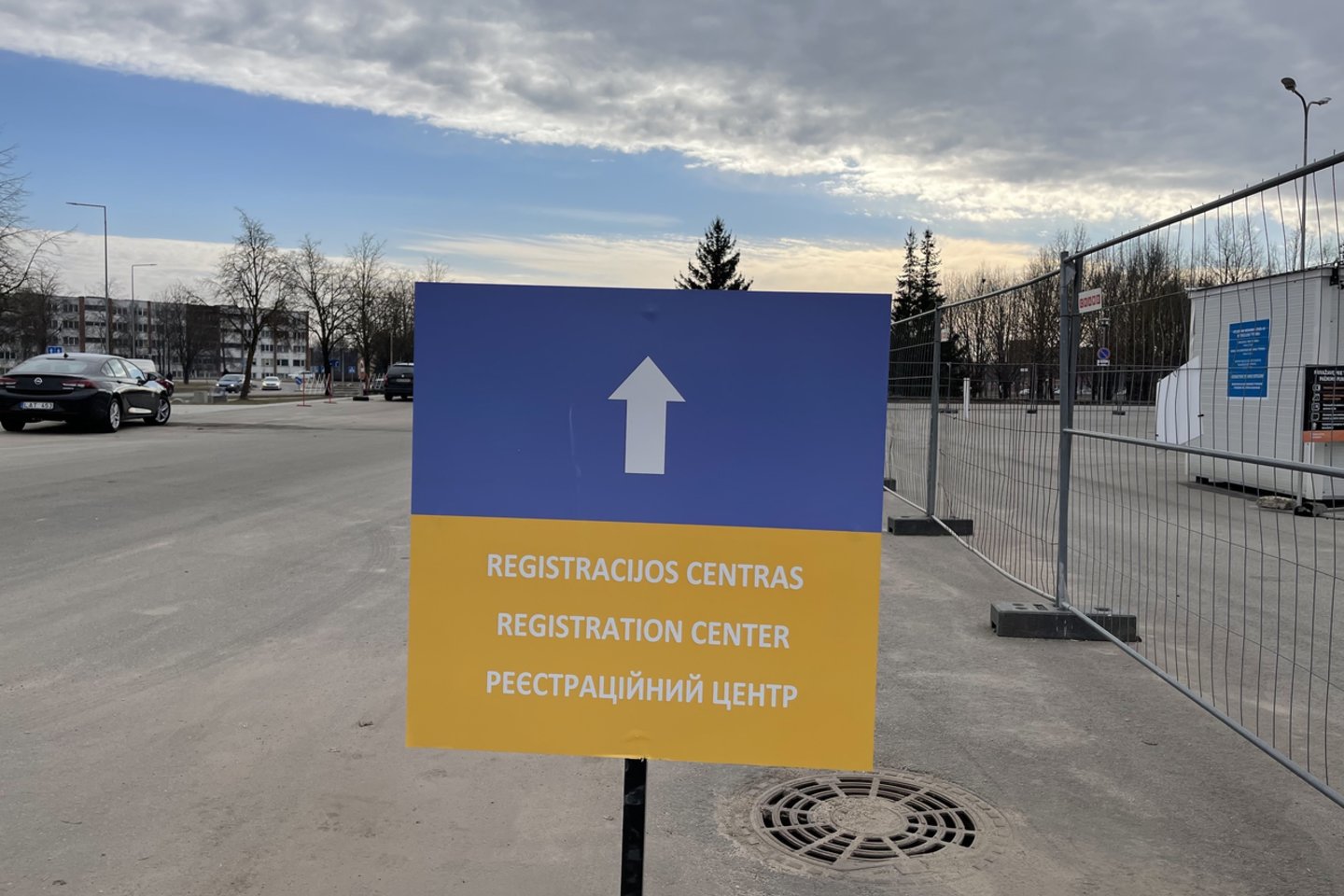
According to the Migration Department, more than 37,000 war refugees from Ukraine – almost 16,000 children and about 21,000 adults – have already arrived in Lithuania since the Russian offensive began on 24 February. 99% of them are Ukrainian citizens.
The United Nations Refugee Agency reported on Wednesday that 4 million Ukrainians have already crossed the country's borders to flee, with 2.3 million fleeing west to Poland.