
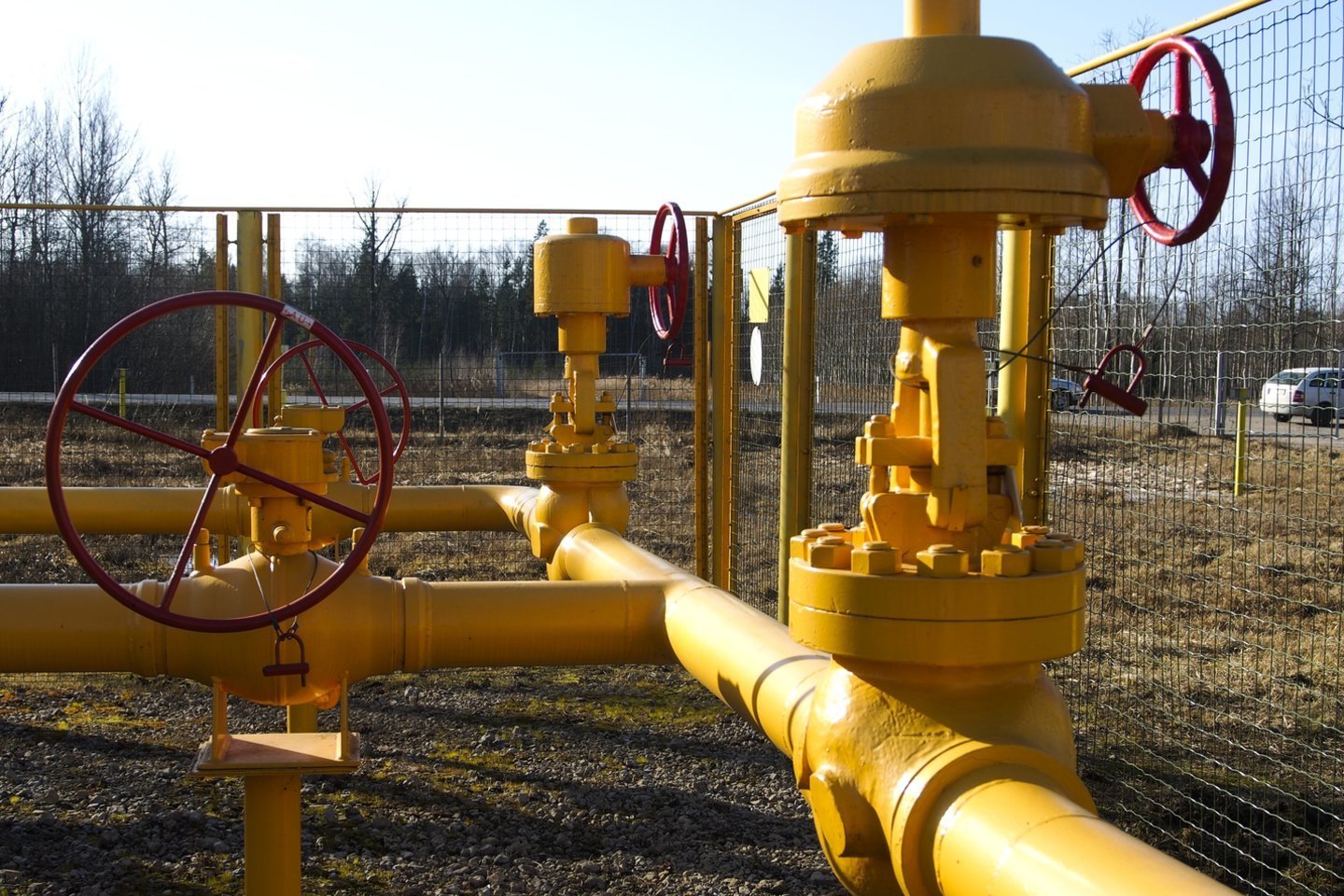
According to economist Alexander Izgorodin, gas prices in Lithuania would skyrocket. „This would be a radical, horror movie scenario, but knowing our neighbours, I would not rule it out“, he said.
However, although all energy experts interviewed by lrytas.lt agree that anything can be expected from Belarus' authoritarian leader, they hope that Belarus will not take such a step, as it is unlikely that Lukashenko will dare to get close to the Russian pipeline.
Lukashenko is unpredictable
Martynas Nagevičius, President of the Lithuanian Renewable Energy Confederation (LAIEK), thinks it would not be easy for Belarus to stop gas transit. „The Russians themselves want to sell gas. So this would be a detriment not only to us but also to the Russians. But when the Belarusian leader is so unpredictable, anything can happen.
Belarus itself could lose its image as a reliable partner. However, the Russians have an economic interest in selling gas, it is profitable for them, and they live off it. So yes, they can blackmail Europe through gas, but if they don't supply them with gas, they would have no income – so there is a kind of mutual dependence,“ Nagevičius said.
Arvydas Sekmokas, former Energy Minister, shares the same view. „Today, apparently, everything is probable. But as Belarus would lose revenue from gas transit and Russia from gas sales, it would be more likely that Russia could cut off gas supplies to Europe. Whether or not this would happen is difficult to say“, he said.
According to the former minister, if gas supplies were cut off, the likelihood of a price increase would be high. Therefore, Sekmokas believes Lithuania should start securing gas supplies through the liquefied natural gas terminal in Klaipėda.
Nagevičius also urged Lithuania to prepare for the worst-case scenario and plan alternatives. He said it was simply a matter of reducing dependence on fossil fuel imports in the long term.
Russia is afraid that Lithuania will stop supplying gas?
However, Vidmantas Jankauskas, an energy expert and professor at Vilnius Gediminas Technical University (VGTU), was of a completely different opinion: if Belarus were to take such a step, Lithuania would not have any major problems, as the pipeline that already runs through Belarus to Poland, of which Lithuania has a branch, is practically virtually devoid of gas.
According to the professor, at one point, there was even a situation where gas was flowing through this pipe in the opposite direction, from Germany to Poland, instead of flowing through Poland to Germany as usual.
„In general, this winter Russia has reduced its gas supply significantly, which is one of the reasons why gas has become so expensive for Europeans. He explained that the gas used to flow through Ukraine, through the Baltic Sea bed, but not through that pipe“, he explained.
Susiję straipsniai
According to the professor, if gas is flowing, it is to Kaliningrad. „Now Lithuania has an excellent gas supply, as do all the Baltic countries – you can't even compare it to what it was ten years ago. Now we have a connection with Poland, 1.5 years ago, Estonia connected with Finland. Now we also have a terminal in Klaipėda and another storage facility in Latvia. So if Belarus were to threaten Lithuania in this way, such words would be worthless,“ said Jankauskas.
Russia is much more prepared than Lithuania for possible difficulties, he said. For example, Lithuania has only promised to connect its electricity system to the European continental grid and is still in Russia's zone, while Russia has prepared Kaliningrad as if it were a closed fortress.
„Kaliningrad is almost ready for war – it has built a couple of additional gas-fired power plants and, because the gas is transiting through Lithuania, it has acquired a gas import terminal – a ship similar to ours – and built a gas storage facility.
Russia explains that it is prepared if we suddenly stop the gas supply – well, you know how they see us. So Russia would not be at all worried if Belarus were to stop gas flowing through Lithuania. But it is very hard to believe that Lukashenko would dare to interfere with that pipe – after all, it is not Belarus' pipe, but Moscow regulates who flows through it and who can use it,“ the professor said.