
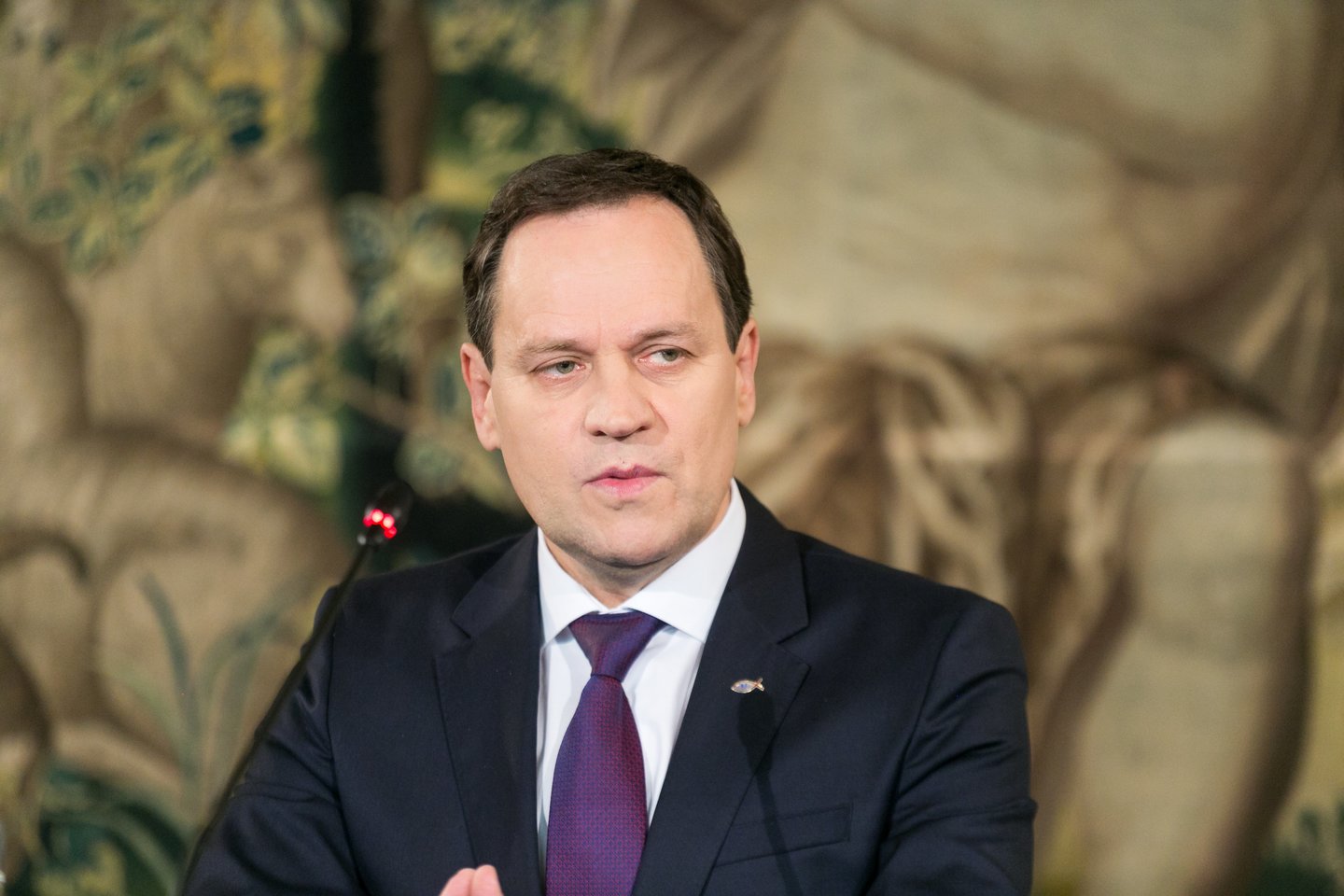
And although Tomaševskis, commenting on the outbreak of the war in Ukraine, is once again rather ambiguous about the causes of the conflict, he is unequivocal in his condemnation of Russian aggression in Ukraine. That is why, says the MEP, he and his political comrades have decided not to celebrate Midsummer in the context of hostilities. However, with Russian troops destroying people and cities in Ukraine, the "censorship" and the resulting obstacles to listening to Russian songs, notes the LLRA-KŠS Chairman, are undemocratic and a precedent that incites national discord. When Russia invaded Ukraine in the early hours of 24 February, the Lithuanian Radio and Television Commission announced that it was suspending 6 Russian channels because of war propaganda and warmongering. Private companies have also announced that they will stop the retransmission of dozens of Russian channels.
"I take a negative view of this. It is first of all censorship, it is an action against democracy, against our freedom. We are aware that the situation is tense, that there is practically a war going on", the politician told Elta.
Although Tomaševski said he did not support the restriction of Russian channels, the Kremlin's actions in Ukraine were condemned out of hand by him and his political associates. Not only that, but the politician noted several times that he and his colleagues did not celebrate, as a matter of principle, the March 1 Mardi Gras. "We condemned it immediately, the Polish Union condemned the invasion of Ukraine. On the same day - Thursday - we cancelled all the events, the Mardi Gras. We did it - the national minorities, the community of Vilnius Region. Because people are dying, we cannot have fun. We did it, but the others did not cancel Užgavėmas, they were in Rumšiškės and so on. This shows that we are very much alive because of this situation. In no uncertain terms," the MEP said.
However, Tomaševskis did not see the decisions to stop the media spreading Russian propaganda as unequivocal. The politician said he understood that war conditions dictated their own logic, but, he stressed, the suspension of Russian channels did more harm than good. The MEP argued that this creates incentives to incite national discord. Therefore, he argued, any decision-making simply had to separate politics from sport and culture.
"We need to separate these issues. Clearly, there is a war going on. Practically the whole of Europe is in favour of this war. There is also an information war. If one or other information channel is cut off during a period of time, there is a logic - the logic of a state of emergency. That is a certain logic, and I cannot be too harsh, because it has always been that way in the world and it will always be that way in all conflicts. Russia does it and others will do it. One or the other media outlet may be offended that this is the case, but we will not change it", the politician reasoned.
"But there is another very important point - why are all the other channels switched off where there is not even news. Why are the channels where there is no news, where there are only films or some entertainment programmes switched off? This cannot be, it is an indication that everything is bad that is linked to the Russian people. This is wrong", Tomaševskis said angrily.
And it is in this context, he explained, that national discord is being incited.
"I take a very negative view and I protest against that. I have received calls from voters and I have said, as a European Parliamentarian, that this kind of incitement to national discord cannot exist in the media. It is a crime. If we do not stop it today, we will have very serious consequences tomorrow," he said.
The politician did not get into the debate that trying to distinguish between where culture begins and politics ends, as far as Russian propaganda is concerned, is very difficult. He insisted that the stance taken in Lithuania on the broadcasting of Russian channels was a threat to people of Russian nationality.
"Today there is a threat to some representatives of our national minorities. Russian nationalities in particular. We want to protect them. Songs and cultural channels cannot be stopped," he said.
Mr Tomaševski took a similar view of the sporting world's high-profile reaction to Russian aggression. The Kremlin's actions in Ukraine have led to various sanctions and the cancellation of various sporting events. However, Tomaševskis believes that this decision is also excessive. The restrictions imposed, the politician argued, also incite national discord. The politician reiterated that, even though a war has broken out, a separation between politics and culture is necessary.
"There is no need to extend it to culture, to sports, to songs", said the politician, who just a minute ago said that it was not appropriate to celebrate the festival of Midsummer during the war.
"You think people are ignorant? People need to be given the opportunity to listen to everything. News broadcasts, political broadcasts - in this difficult period... This has always been the case and will always be the case", the politician said, categorically rejecting the idea that the restrictions on Russian media in a number of countries around the world are a necessary tool to stop Kremlin chauvinism.
"What is the point of Russian songs and the Raduga radio station in Klaipėda. This nonsense must be stopped", he said.
Susiję straipsniai
He did not get involved in the debate on Russia's aggression in Ukraine: it is one long nonsense
As for how to counter Russia's aggressive policy, Tomaševskis did not want to comment. The politician only made it clear that the reasons for the Kremlin's aggression in Ukraine are not only linked to the flawed nature of the Russian regime, but also to the circumstances in Europe and Belarus.
"I don't want to comment on that because it is one long nonsense. A long period of cheap politicking has led to this unacceptable situation and military action. I spoke about this two years ago, when the artificial conflict in Belarus was created. We should not have been looking for some kind of revolution. If it had not been for that, we would have an independent Belarus today. We ourselves pushed Belarus into Russia, which practically swallowed it. And when it swallowed it up, what has already happened happened. A new border has appeared on the Belarusian border. But I will not comment any further on this, because it is impossible to comment on it", the politician said.
V. Tomaševskis has previously tended to highlight various circumstances in Europe or inside Ukraine when assessing Russia's aggression against Ukraine. For example, commenting on Russia's occupation of Crimea in 2014, he said that allowing the formation of Kosovo had opened a "Pandora's box".