
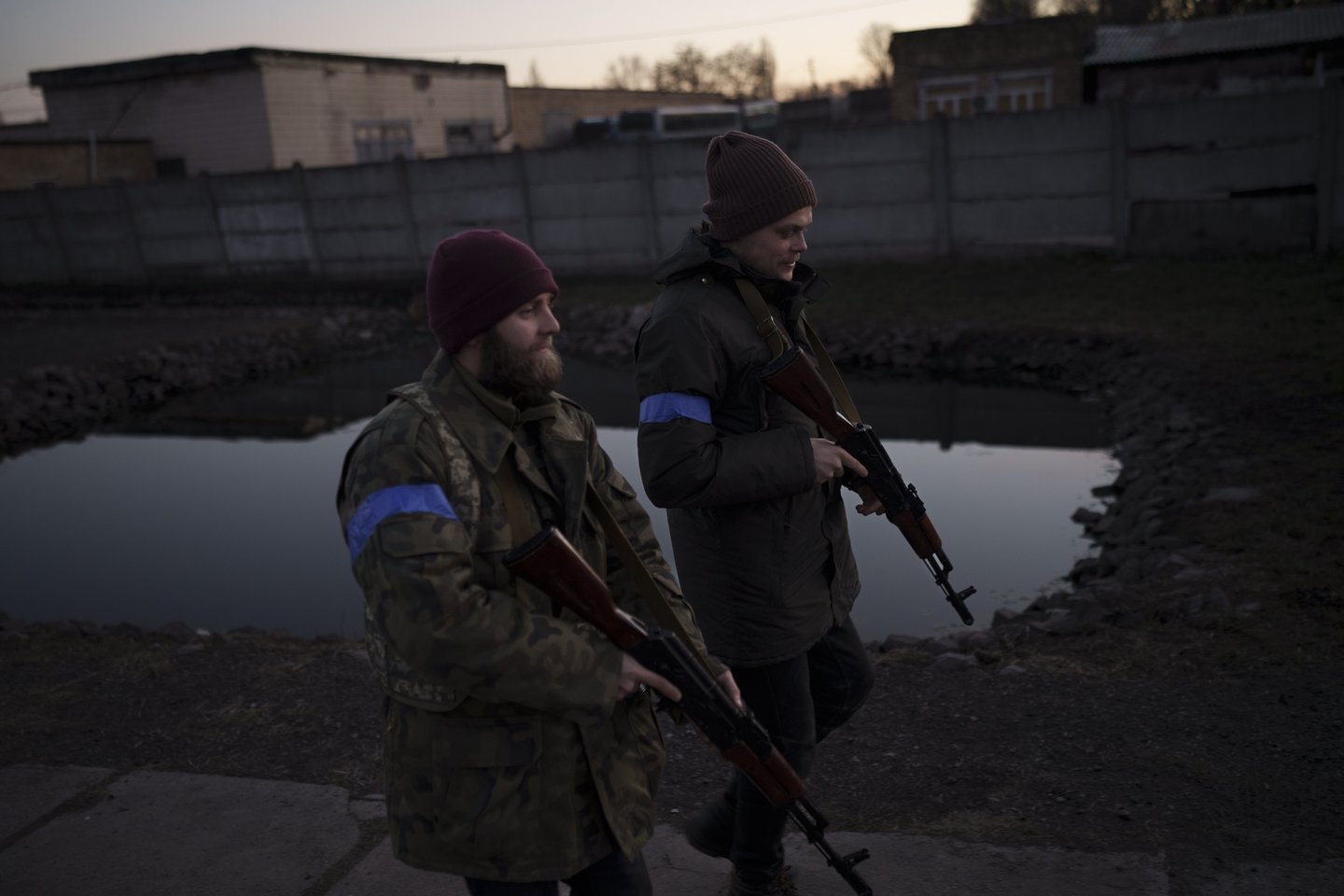
Political analyst D.Šlekys assessed the current course of the war and the likely future scenarios, the likelihood of a possible ceasefire and the threat to the Baltic States on Žinių Radio.
The current phase
The current situation in Ukraine indicates that Russia's war against the country will be prolonged, said D.Šlekys, a lecturer at the VU Institute of International Relations and Political Science and an expert on warfare, in the programme of "Žinių Radio".
"From the way the action is unfolding now, it will be a sick, long conflict. The Russian forces cannot encircle Kyiv, let alone storm it. Kharkiv, Sumy, Chernihiv are also holding out, although forces are massing there.
Perhaps the biggest action is in the south and East, where the Russian army seems to be slowly, painfully, but unfortunately, increasingly pressing the Ukrainian regular forces deployed below Donetsk towards Mariupol, which sooner or later will have to retreat closer to the Dnieper, or will remain in what is known as a pocket of encirclement, and then breaking through, escaping, will be more difficult.
The problem is also coming from the south because from Kherson onwards, the Russian forces are slowly moving upwards, moving towards Zaporizhia, and will increasingly start to move towards the Dnieper. This means that they can control almost the whole of the left bank, which would cause problems if the Ukrainian forces had to move to the right bank, realign, regroup.
Therefore, a serious question awaits the Ukrainian leaders - whether to try to pull out these troops slowly at some point, which would essentially mean burying Mariupol and abandoning it to its fate, because then all the Russian forces in the East would surely tighten their grip on the encirclement ring even more", Šlekys said.
The next ten days
According to the military expert, Russia itself clearly understands that the next ten days will be decisive in deciding the future actions of its military.
"According to US intelligence, Russia has activated all the troops it had mobilised on the border. This means they do not have the reserves to keep up the pace in close geographical proximity.
So if all these troops that have now been committed to the fight fail to make a breakthrough, whether at Kyiv, Kharkiv or in the East, their operational tempo will start to slow down - the troops will get tired, the equipment will break down. So then we need a pause to refresh the troops, bring in reserves, repair the equipment, and bring in ammunition. (...)
If Russia does not make a breakthrough in the next week and a half, it will be forced to pause to regroup - to bring both men and weapons from the interior of Russia," Šlekys forecast.
A breakthrough, he said, could be the seizure of a major Ukrainian city such as Mariupol.
"The question is what will be the dynamics in eastern Ukraine, how fast they can force the Ukrainian forces in the East to retreat. And whether they could manage to take at least Mariupol in this time by striking from a distance - they are already practically not choosing their targets.
The political analyst noted that this would be a kind of prize to show to the Russian audience - to raise their spirits that we are winning and to soften the resistance to the announced mobilisation".
At the moment, he said, Russia needs at least one material "prize" to show its audience that something has been achieved. Taking a bigger city, according to Šlekis, would also be an important bargaining chip for the Kremlin.
"At some point, I'm afraid that President Zelenki will have to go into some kind of conversation (with the Russian side - author's note) because even the Ukrainian side will need some kind of operational pause".
Suppose Russia were to occupy a significant part of Ukrainian territory. In that case, Shlekys does not rule out that the Ukrainians could take temporary solutions and agree to a ceasefire, which could be temporary or could last for decades.
"Formally, the Korean War is not over - the armistice continues to function between the two Koreas, with a demilitarised war zone in between," the political analyst noted.
But for such a truce, according to Shlekis, Russia needs Kyiv, a mission that has so far been unsuccessful for the Russian army.
"So far, the storming of Kyiv has not been so drastic - apparently, the Russian authorities need Kyiv still functioning as a city. The southern zone is not under siege. Even in the north-west and the north, their offensive has paused.
It is a long, bloody, city-destroying battle just to surround Kyiv, a city of this size, and then go into its streets, given that those who have been preparing for the defence of Kyiv have been fortifying the perimeter from the very first day of the war. Unless Russia wants Kyiv to be replaced by one big glade with ruins," Šlekys said.
The political analyst is convinced that how long Russia's war in Ukraine can last will ultimately depend on Russian society.
"The regime will only be able to keep up the pace of the war militarily if it can send conscripts to the front line, call up reservists who have served for a long time. How will the people whose children have just been drafted and are being sent to fight, or their parents, react? Will people be angry, or will they support them? How will Russian society react?
The regime's army will fight as long as there is public support. Whether the Russian public will rise up, I am more on the pessimistic side at the moment", Šlekys admitted.
Susiję straipsniai
What is the danger for the Baltic States?
There are still voices in the public sphere who believe that if Putin defeats Ukraine, the next countries to be attacked will be the Baltic States. But how likely is it that Putin, having suffered such losses, would repeat a similar military manoeuvre on NATO's borders?
"The Russian army is suffering losses. The troops, some with long training, especially the paratroopers, will not be replaced that quickly. The equipment is either destroyed or defective - it will take time to repair, upgrade, manufacture.
Moreover, according to the political scientist, the West has woken up to the reality of inter-state war and is changing its tactics from deterrence to defence.
"We are seeing thousands of NATO allied forces arriving in our country. (...) NATO has tried to build a deterrent to Russia, but now our politicians and the leaders of other countries are saying that we have to move to defence.
This means that troops from other countries are no longer military tourism. They are fully prepared, with procedures in place to be ready and live, if necessary, to fight here and now. In this case, we can thank Putin, because if there were any doubts in the West, they have disappeared", concluded Šlekys.