
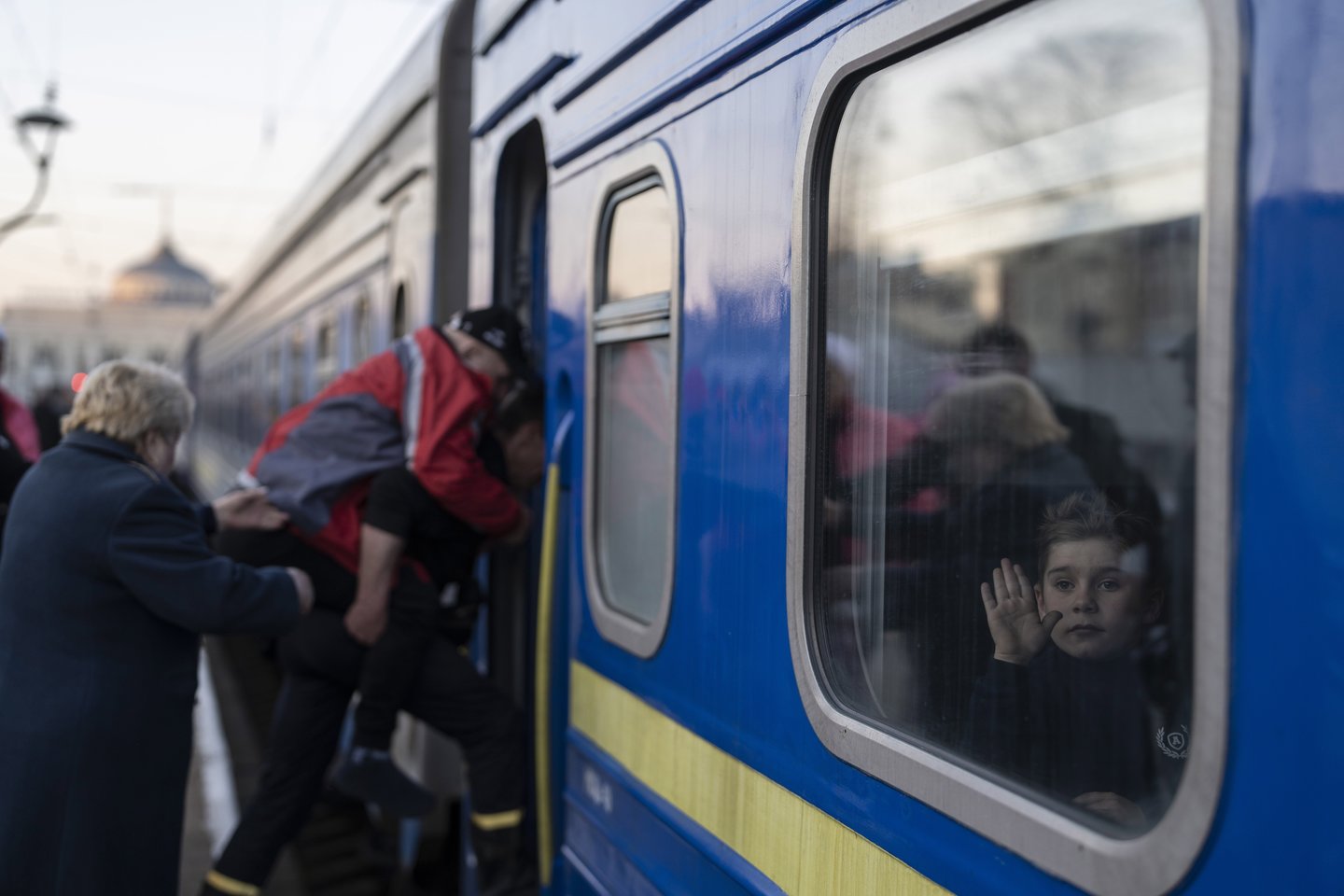
For their part, communication experts assessed the impact of the Kremlin's propaganda in Lithuania, what the regime's goals are in creating narratives about Ukrainian war refugees, and how to identify liars.
They urged a cautious judgement
Ukrainians complaining about Lithuania's living conditions claim the government forgets Lithuanians, jobs are being taken away, and children are being denied kindergarten places. These and similar myths have been circulating in the public domain lately.
Prime Minister Šimonytė noted that the number of such messages is only increasing.
"There will be propaganda, so we have to be careful. (...) There are more and more such messages in the public space. The propaganda mill is also contributing to it, the aim of which is to discredit the Ukrainian struggle for independence, so we have to be very careful with such messages," said the Prime Minister.
However, she stressed that there are all kinds of people, and therefore real situations can be different. "My volunteering experience at the registration centre is that people are usually very tired and emotionally very exhausted. The most common request I hear from people (...) is just to be able to put their head on a pillow somewhere safe and rest," said Šimonytė.
What are her goals?
Arūnas Armalis, a public relations specialist, told lrytas.lt that it only takes a dozen or a few dozen Kremlin propagandists operating in Lithuania for sensitive groups of the public to absorb and disseminate such information on a much larger scale.
"I see this as information being pumped out and picked up by sensitive groups. It was only a matter of time before certain groups of society started to have a skewed view of refugees", Armalis believes.
According to him, the narrative of how the Ukrainians will take away Lithuanian jobs is most easily perpetuated in low-competitive professions, such as bakers or tailors, where the language barrier is less important.
"But such people always need a spark of information, which I think is provided by a regime hostile to us. And until then, it was trying to divide our society, and now it is doing so by trying to intimidate Ukrainians", said Armalis.
The communications expert recalls that the first lies about Ukrainian war refugees allegedly stealing from Ukraine were spread in Poland in the first week of the war when it became clear that this was the main destination of refugees. According to him, the same propaganda is being exported to Lithuania.
"The more Ukrainians appear in the country, the more reason there is for fear-mongering. And by creating fear, the Kremlin is doing what it has always wanted to do - to foster distrust in its own government, in the European Union, in NATO, and to increase the divisions in society," he explained.
By spreading narratives that antagonise the public, Mr Armal said, Russia is trying to have as many Hungarians as possible in the EU.
"Russian propaganda is trying to bring the alt-right (far-right - author's note), supposedly nationalist, nationalist Eurosceptics to power in an attempt to weaken the EU.
In Lithuania, such information coincided with movements supporting people who are dissatisfied with the EU and NATO. The ultimate goal is to have as many Hungarians as possible in the EU", said Mr Armalis.
"We see what Hungary is saying - it is now against the supply of arms to Ukraine. This is a very convenient ally for Russia", he added.
How many people are affected?
However, Armalis is convinced that only a small percentage of the public in Lithuania is affected by Kremlin propaganda and that the percentage could be estimated from a recent poll that asked how many people in the country would defend Lithuania if Russia attacked it.
"We have a recent poll on how many people are ready to defend the country with arms or other means - we see that almost 80% would defend the country and 20% would not," he recalled.
According to Armalis, the Kremlin's narrative to intimidate, create discontent, and anger is being created in different cuts, and messages are being created for different layers of society. "If I am confident about my job, I might be worried about places in kindergarten or school", he noted.
Armalis suggests that if one hears similar messages, one should ask oneself who benefits from such a narrative and who is disseminating this information.
"The main advice when you hear such a message is to ask yourself, 'What is the best use of this? Who benefits most from saying that the Ukrainians will take away my job, my child's place in kindergarten?
One should seek additional information, not believe the first message, the first number. Also, see what kind of people are sharing such information. If that person has spoken out against most of the state's decisions, then ask the question, why do they keep speaking out against the state's decisions?" - he pointed out.
Is Lithuania more united than ever?
Mindaugas Lapinskas, a communications expert, told lrytas.lt that some commentators and political analysts overestimate the impact of commentators spreading disinformation and that they are mistaken in assuming that "hordes" of such commentators are real people, who are sometimes referred to as the "voice of the people".
Mr Lapinskas himself stated that he sees more smoke than fire in this case.
Susiję straipsniai

"Undoubtedly, the Russians have special operations which, if they do not directly burn the friendship between Lithuanians and Ukrainians, at least pump gasoline vapour into the internet space to make these topics burn better", he said.
According to Lapinski, it is easy to spot the lies that are being spread - the stories and phrases are repetitive, and the scenarios are simple.
"It doesn't take many brains to create a lie about 'I saw Ukrainians sitting in a café in a shopping centre and giving a hundred euro note and not asking for change', it is easy to remember the story and repeat it", he noted.
According to the expert, propaganda is aimed at general instability and confrontation and at weakening the world's resistance to Russian aggression.
"Even though just before this aggression, we talked a lot about Lithuania's confrontation, about the gaps between one or other groups of society, after 24 February Lithuania is as united as it has ever been in its history - except maybe during the years of independence. That is why such comments and attempts to divide do not have such a great effect, except that someone makes money out of it.
And if someone writes such comments sincerely, they are just fools because they could also get money from the Russians for such comments," said Lapinskas.
"Those propagandists or propaganda channels have compromised themselves enough and continue to compromise themselves. Sooner or later, they will come to an end. If we wanted to hasten it, information hygiene would be useful for everyone. Portals have banned anonymous comments, and public space has been refreshed. The more lies trolls create, the easier it will be for people to spot them", he believes.