
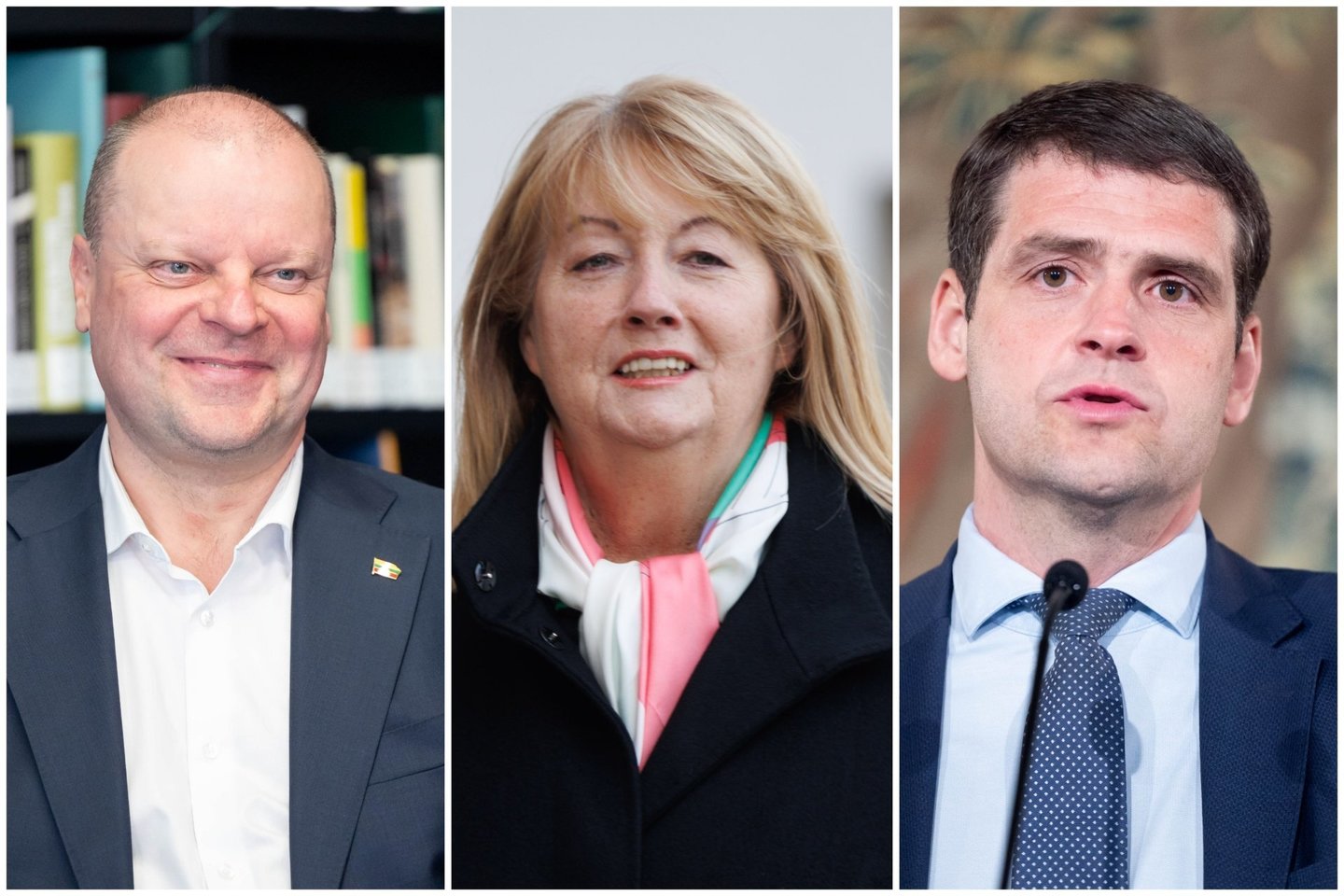
This is according to a public opinion poll carried out in September by Baltijos Tyrimai on behalf of Elta.
According to the survey, which took place on 6–20 August, 54% of the respondents favourably evaluated the leader of the Social Democratic Party of Lithuania (LSDP), which is currently leading in the party rankings, in September, while 50% of the respondents favoured Blinkevičiūtė, 50% favoured Žemaitaitis, and 46% favoured Skvernelis.
Slightly more than a third of the survey respondents have a favourable opinion of the leader of the electoral list of the Lithuanian Peasants and Greens Union (LVŽS), Aurelija Veryga (38% favourably, 49% unfavourably), the Chairman of the Party of Regions of Lithuania (LTRL), Jonas Pinskus (37% favourably, 38% unfavourably), and the Head of the Liberal Movement, Viktorija Čmilytė-Nielsen (36% favourably, 53% unfavourably).
Susiję straipsniai

The most unfavourable respondents were Ingrida Šimonytė, the leader of the Homeland Union-Lithuanian Christian Democrats (TS-LKD) (70% unfavourably, 22% favourably) and Aušrinė Armonaitė, the chair of the Freedom Party (68% unfavourably, 21% favourably).
The Chairman of the Union of Polish Electoral Action-Christian Families, Waldemar Tomaszewski (66% unfavourably and 13% favourably), the first candidate of the Peace Coalition Viktor Uspaskich (64% unfavourably and 13% favourably) and the first candidate of the Peace Coalition Viktor Uspaskich (64% unfavourably and 13% favourably) also had a low level of support from the respondents. The leader of the Lithuanian People's Party, Eduardas Vaitkus (63% unfavourably and 16% favourably), and the Chairman of the Freedom and Justice Party, Artūras Zuokas (61% unfavourably and 21% favourably).
Some of the candidates are unknown to the population
With only a few days to go before the Seimas elections, some of the political forces' leaders are not well known to the surveyed population. According to the survey, about one in four respondents have not heard of Vytautas Sinica, who is leading the National Alliance to Parliament (37% unfavourably and 11% favourably). The same proportion—26%—had no opinion about the leader of the list.
24% had not heard the name of the Chair of the Lithuanian Green Party, Ieva Budraitė (33% unfavourably and 18% favourably), and 25% had no opinion about her. Artūras Orlauskas, the first candidate on the list of the Union of People and Justice (centrists, nationalists) (50% unfavourably and 21% favourably), is not known to 6% of the respondents, and 23% did not have any opinion about his ideas.
Trust in Skvernelis and Blinkevičiūtė increased
The latest poll shows that people's trust in public figures has changed slightly over the month, with a five-point increase in the positive assessment of Skvernelis and Blinkevičiūtė. The number of respondents who have a favourable opinion of LVŽS President Ramūnas Karbauskis has also increased by four percentage points (39% have a favourable opinion of him, 48% have an unfavourable opinion of him).
In addition, MEP Virginijus Sinkevičius's evaluations (48% favourably and 30% unfavourably) and Armonaitė's increased by three percentage points.
The rating of Žemaitaitis dropped
In September, the number of respondents with a favourable opinion of journalist Andrius Tapinas dropped by five percentage points (43% favourably and 43% unfavourably), and the number of respondents with a favourable opinion of Žemaitaitis dropped by four percentage points (50% favourably and 37% unfavourably).
In addition, the number of those who have a favourable opinion of Kaunas Mayor Visvaldas Matijošaitis (34% favourably and 52% unfavourably), the Chairman of the Union of Nation and Justice (centrists, nationalists), MEP Petras Gražulis (26% favourably and 63% unfavourably), and the president's candidate Vaitkus (26% favourably and 63% unfavourably) has decreased by three percentage points.
Leaders of the ruling coalition are among the most unfavourably viewed politicians.
All three ruling coalition leaders are among the politicians with the most unfavourable ratings in the first month of autumn. They are Gabrielius Landsbergis, Chairman of the TS-LKD (78% unfavourably and 15% favourably), Armonaitė and Čmilytė-Nielsen.
As early voting continues, another batch of leading politicians cast their vote
The survey also showed that Vytautas Landsbergis, Chairman of the Supreme Council and the Seimas (74% unfavourably and 17% favourably rated), Prime Minister Šimonytė, Gražulis, Vaitkus, and Matijošaitis were the most unfavourably rated politicians in September.
The most favourably perceived are Adamkus and Nausėda
At the same time, the most favourably evaluated public figures continued to be the outgoing President Valdas Adamkus (favourably by 78%, unfavourably by 12%) and the Head of State Gitanas Nausėda (favourably by 73%, unfavourably by 19%).
More than half of the respondents also had a favourable opinion of former President Dalia Grybauskaitė (59% favourable, 32% unfavourable), Blinkevičiūtė (54% favourable, 36% unfavourable), Žemaitaitis, Sinkevičius, Skvernelis (46% favourable, 43% unfavourable), and the mayor of Širvintai district, Živilė Pinskuvienė (45% favourable, 37% unfavourable).
Other politicians and public figures evaluated in this survey were rated more unfavourably than favourably.
The rating of Karbauskis has increased the most in four years
Compared to the survey conducted before the 2020 Seimas elections, the favourable assessment of Karbauskis, who was to leave the opposition, has increased the most in four years – by 11 percentage points. The number of people with favourable opinions of Žemaitaitis has also increased by nine percentage points. In comparison, the number of people with favourable views of Veryga has risen by eight percentage points. The number of people with favourable views of Blinkevičiūtė has increased by six percentage points.
At the same time, Matijošaitis and Armonaitė's ratings have decreased the most in four years, by 17% points. The share of the population supporting conservatives Šimonytė and Landsbergis, who are the leaders of the ruling majority, decreased by 15 and 10 percentage points, respectively.
The poll took place from 6 to 20 September 2024. It was carried out through personal interviews with 1004 Lithuanian citizens (aged 18 and over) at 110 sampling points.
The composition of the respondents corresponds to the composition of the adult population of Lithuania in terms of gender, age, nationality and type of settlement. The people surveyed reflect the opinion of the Lithuanian population aged 18 and over. The margin of error of the survey results is up to 3.1%.