
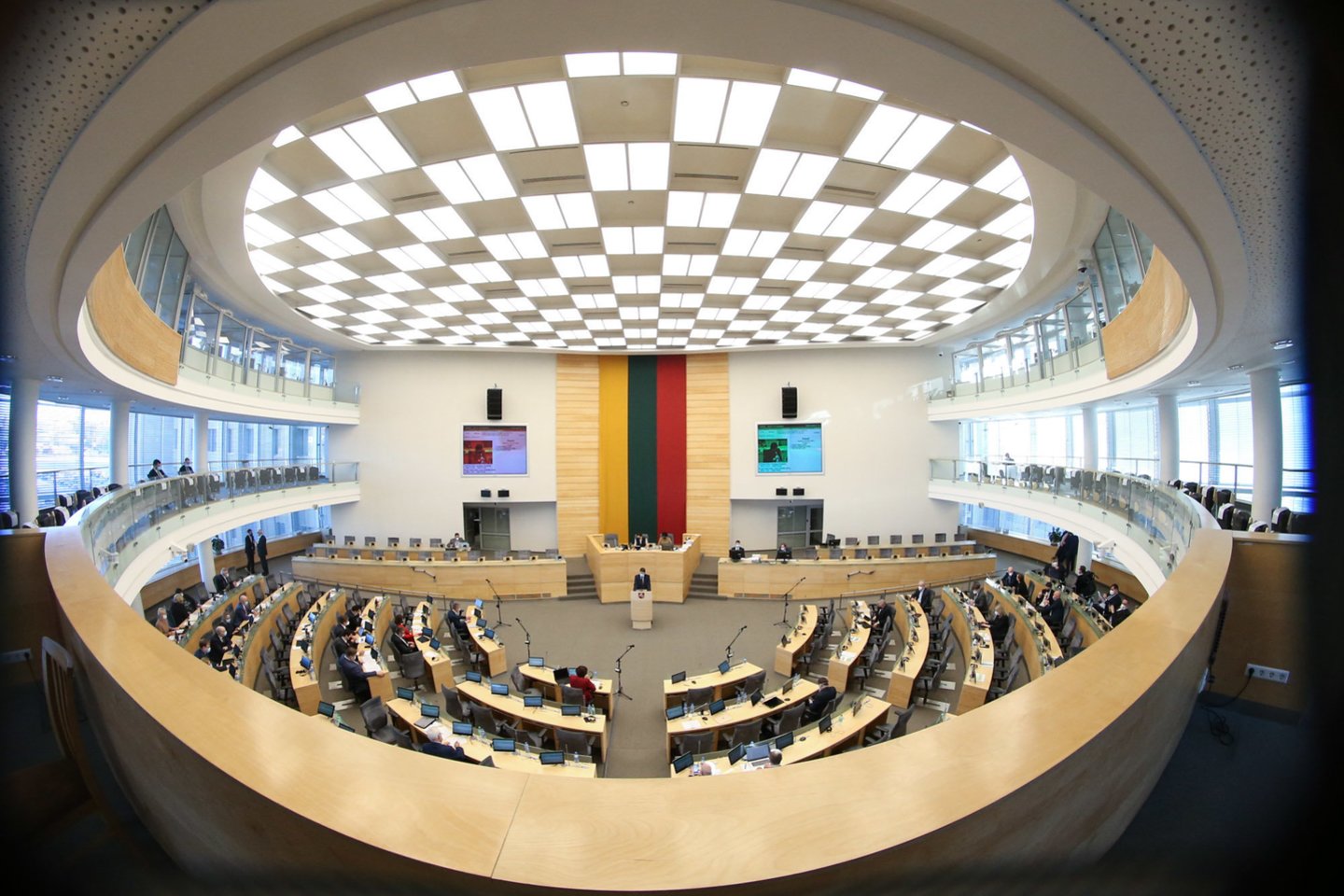
The Seimas Committee on Law and Order decided this on Wednesday after assessing the Law Department's conclusions. Six members of the Committee saw the draft as potentially unconstitutional, with one abstention.
According to Julius Sabatauskas, the Chairman of the Seimas TTK, all Seimas will have to vote on the Committee's conclusion. The parliamentarians' decision will determine whether the draft law will be submitted to the plenary session.
According to Viktorija Staugaitytė of the Legal Department of the Seimas Chancellery, some of the provisions of the draft Law on National Minorities may contradict the Constitution.
Susiję straipsniai

„These include provisions relating to the right of representatives of national minorities to communicate with public administration entities in the language of the national minority, the writing of the names of representatives of national minorities in documents and the change of electoral constituency boundaries without violating the rights of national minorities,“ Staugaitytė said at the Committee's meeting.
In the opinion of Seimas lawyers, the proposal to allow municipalities where a national minority makes up at least 10% of the total population to communicate with public administration entities in the language of the national minority is unconstitutional.
„The adoption of the proposed provisions would legalise the use of national minority languages in public life instead of the official language, which is unconstitutional,“ the Seimas lawyers said, referring to the official constitutional doctrine of the official language.
The law also proposes to regulate the spelling of national minority names in official documents. The names and surnames of such residents would be spelt in documents according to the spelling rules of the national minority language if they so wish. It is also foreseen that the name of a person belonging to a national minority could be written in Latin characters with diacritical marks.
„Even those personal names which are originally written in non-Latin characters (e.g. Cyrillic, Hebrew, Armenian, other non-Latin characters) should be written in their original form,“ the Law Department noted in its conclusion, considering this unconstitutional.
According to the Seimas lawyers, Lithuanian citizens' non-Lithuanian names and surnames may be written only in Latin-based characters in identity documents as long as, in the opinion of the State Commission for the Lithuanian Language, they are in line with the tradition of the Lithuanian language and do not infringe on the system of the Lithuanian language or its uniqueness.
The parliamentarians who drafted the amendments to the law also propose to oblige the Chief Electoral Commission (VRK) not to violate the rights of the compactly living national minorities when drawing up or changing the boundaries of electoral districts. Suppose the VRK changes the boundaries of electoral districts where ¼ of the electorate belongs to national minorities. In that case, it should set up a working group comprising a geographer, a sociologist and representatives of national minority organisations.
According to Ms Staugaitytė, the Law Department sees this proposal as a „threat to the principle of equal suffrage“. In the opinion of the Seimas lawyers, the proposed legal regulation „does not meet the requirements of the constitutional principle of equal suffrage“.
„Neither the provisions of the Constitution (...) nor the legal regulation laid down in the Electoral Code imply that the High Electoral Commission, when drawing up single-member constituencies in the Seimas (....), should be guided by criteria such as the national identity of the voters, the number of voters belonging to certain national minorities in the constituencies,“ reads the conclusion of the Legal Department.
Rita Tamašunienė and Česlav Olševski, MPs representing the LLRA-KŠS, who were present at the TTK meeting and who drafted a new version of the draft Law on National Minorities, disagreed with this harsh evaluation of the draft. In their view, the adoption of the law depends on the political will of the members of the Seimas.
„We are not saying that the law is perfect, but such a harsh assessment that it is unconstitutional prevents political discussion. The proposed amendments would regulate and enshrine the right of national minorities to equality, to non-discrimination, to participate in public life and other things. In drafting, we looked at best practice,“ said Ms Tamašunienė.
ELTA recalls that on 1 January this year, a new Law on National Minorities, adopted by the outgoing Seimas and initiated by the former Minister of Justice Ewelina Dobrowolska, entered into force.
Although some politicians have called adopting this law a historic event, Rita Tamašunienė, a Member of the Seimas representing the LLRA-KŠS, did not hide her disappointment with its content. She regretted that the Seimas had adopted what she considered to be an empty law that solved nothing and promised to submit a new document.
This promise was fulfilled by Tamašunienė, a member of the Parliament representing the Union of Lithuanian Poles' Electoral Action-Christian Families (LLRA-KŠS), Olševski and Jaroslav Narkevič have registered a new draft law. It deals with the religious identity of national minorities, the prohibition of assimilation, the use of the mother tongue, the right to education, the spelling of personal names, and the possibility of writing the names of places and streets in the language of the national minority.