

However, the Ministry of National Defence (KAM) has a slightly different position. According to Minister of National Defence Karolis Aleksa, weapons should only be used as a last resort, after assessing that the object poses a real threat.
„If it is assessed that there is a huge threat and danger, there are certain procedures that allow restricted areas to be established. A restricted area means that no flights are allowed and military force can be used,“ he told ELTA.
„But these are truly exceptional cases (...). Such decisions must be carefully considered and taken seriously because, even if a restricted zone is declared and the use of military force is authorised, we are well aware that if it is large enough, certain risks will arise. There could be debris that could fall, etc.,“ Aleksa told Elta.
Susiję straipsniai

According to the Deputy Minister, once it has been determined that the object does not pose a threat, it would be inappropriate to use expensive air defence weapons, as suggested by the NSGK Chairman.
„We understand the symbolism, but we want a measured understanding, a measured assessment, because the use of military force is an extreme and last resort. You stop everything in that place for the rest of your life. So, is the drone's flight and its journey through Lithuanian territory worth such action? If we see that it is worth it, then all measures will undoubtedly be taken,“ he emphasised.
The deputy minister also noted that Lithuania is legally at peace, so the use of weapons is subject to strict procedures. According to him, it would not necessarily be rational to use military force against objects that do not pose a real threat.
„If we then have some greater consequences for using force, the question will be whether it was proportionate,“ said Aleksa.
Jeglinskas: let's send a signal that we are ready
For his part, NSGK Chairman Jeglinskas continues to insist that sending a signal to hostile forces would be a good decision. According to him, the fact that a drone flying into the country's territory crashes near the border only highlights the existing shortcomings in Lithuania's air defence.
„The drone flies in and crashes a kilometre away – we are certainly not sending any message. We are only showing that there are enough problems with our airspace defence. We need not only to talk about how strong our air defence is, but also to take action. Let's dare to shoot down even a drone that does not have a warhead. It's probably not a big deal. Let's use kinetic or non-kinetic means. This would send an important signal that we are prepared to do so,“ said the NSGK chairman.
The parliamentarian also criticises fears of escalation that could be triggered by the shooting down of an unmanned aircraft. According to him, fear of escalation is typical of Western countries.
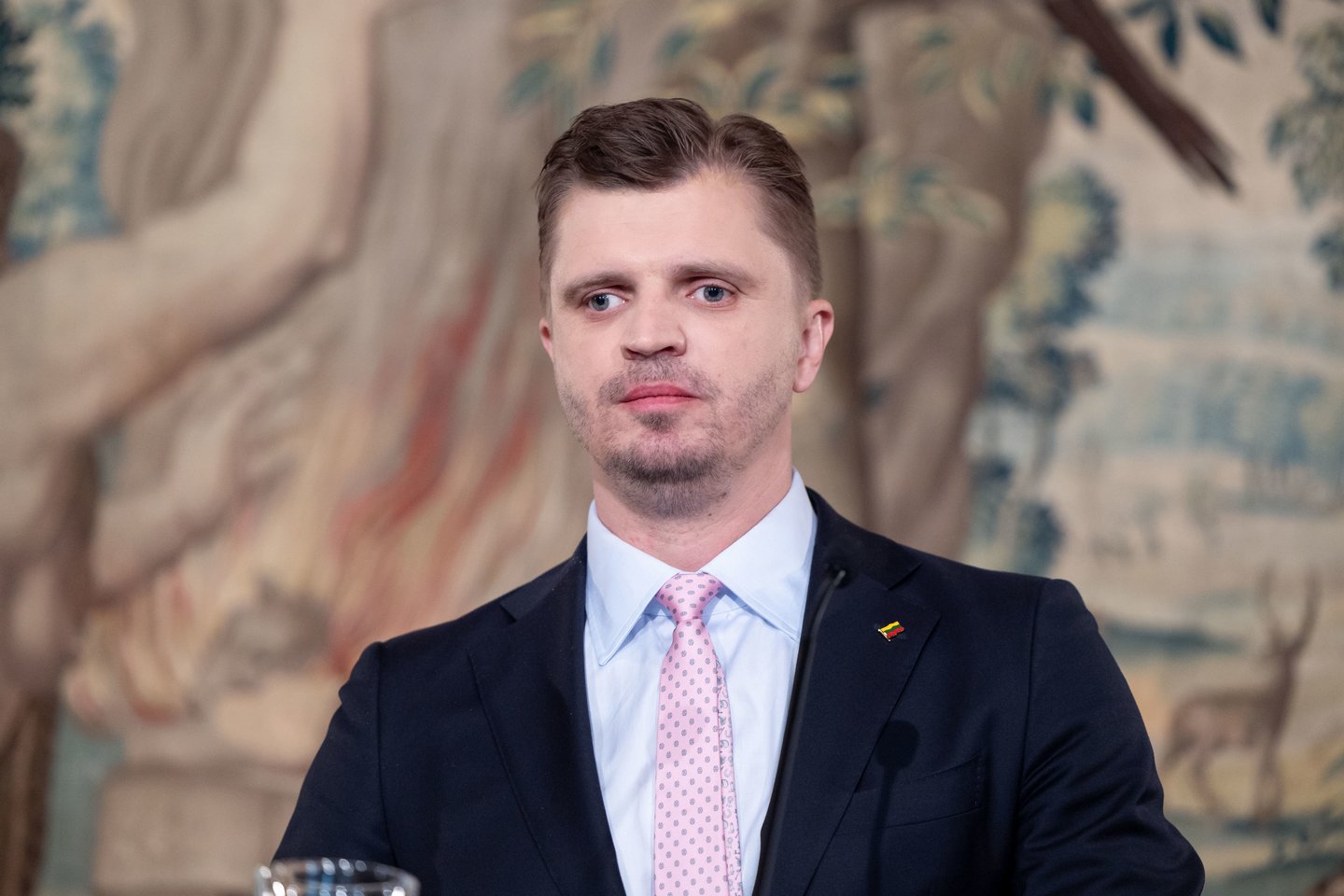
„We are afraid of some escalation. There is no escalation here. A hostile state's drone flies into Lithuanian territory, it is shot down, that's all. The drone is special in that it has no pilot – we are not harming anyone, we are not invading enemy territory, we are defending our territory. We are showing that we have the technical competence and political will to do what needs to be done,“ the politician explained.
Jeglinskas was also sceptical about fears of possible debris if the unmanned aircraft were shot down. According to him, the drone could crash in a residential area anyway, so it would be better to control the situation and choose where to neutralise the object.
VSAT: theoretically, we can shoot it down
For his part, Giedrius Mišutis, spokesperson for the State Border Guard Service (VSAT), said that border guards could theoretically shoot down flying objects. According to him, they are granted such powers by legislation adopted after smugglers began actively attempting to transport cigarettes using balloons.
„In theory, border guards have the right to use firearms against any flying, remotely controlled object,“ commented the VSAT representative.
However, Mišutis emphasised that firearms have never been used against balloons because this requires a detailed risk assessment.
„In each case, many circumstances are assessed before using a weapon.
The use of a weapon near the border, if the trajectory were to point in the direction of Belarus, is not likely. There are villages around, and there is a danger of a shot being fired. Finally, there is the issue of accuracy and accessibility of the border guards' service weapons,“ he said.
As previously announced, Jeglinskas said on Thursday that there are numerous critical gaps in Lithuania's air defence: in detection, warning systems, and neutralisation.
He made these comments after a closed NSGK meeting on Thursday, where the situation involving the Gerbera drone that flew in from Belarus and violated Lithuanian airspace was discussed.
The Lithuanian Armed Forces, for their part, have announced that flying objects violating the country's airspace in peacetime would only be destroyed if they posed a real threat to state security or critical infrastructure. It is emphasised that in peacetime, such a decision can only be made by the Minister of National Defence.
ELTA reminds that on July 10, an unmanned aircraft named Gerbera, which had flown in from Belarus, violated Lithuanian airspace. Initially, the State Border Guard Service (VSAT) reported that the plane, flying at an altitude of 100 meters at a speed of 50–60 km/h, resembled a homemade plane. Shortly thereafter, Minister of National Defence Dovilė Šakalienė confirmed that the unmanned aircraft was a Russian-made Gerbera, designed to imitate Shahed drones and intended to confuse.
After the airspace violation was reported, fighter jets performing NATO air policing missions in Lithuania were instructed to respond. However, after the object crashed, the mission was called off.
According to the authorities, the drone did not pose a threat.
The Lithuanian Armed Forces are investigating the airspace violation.