
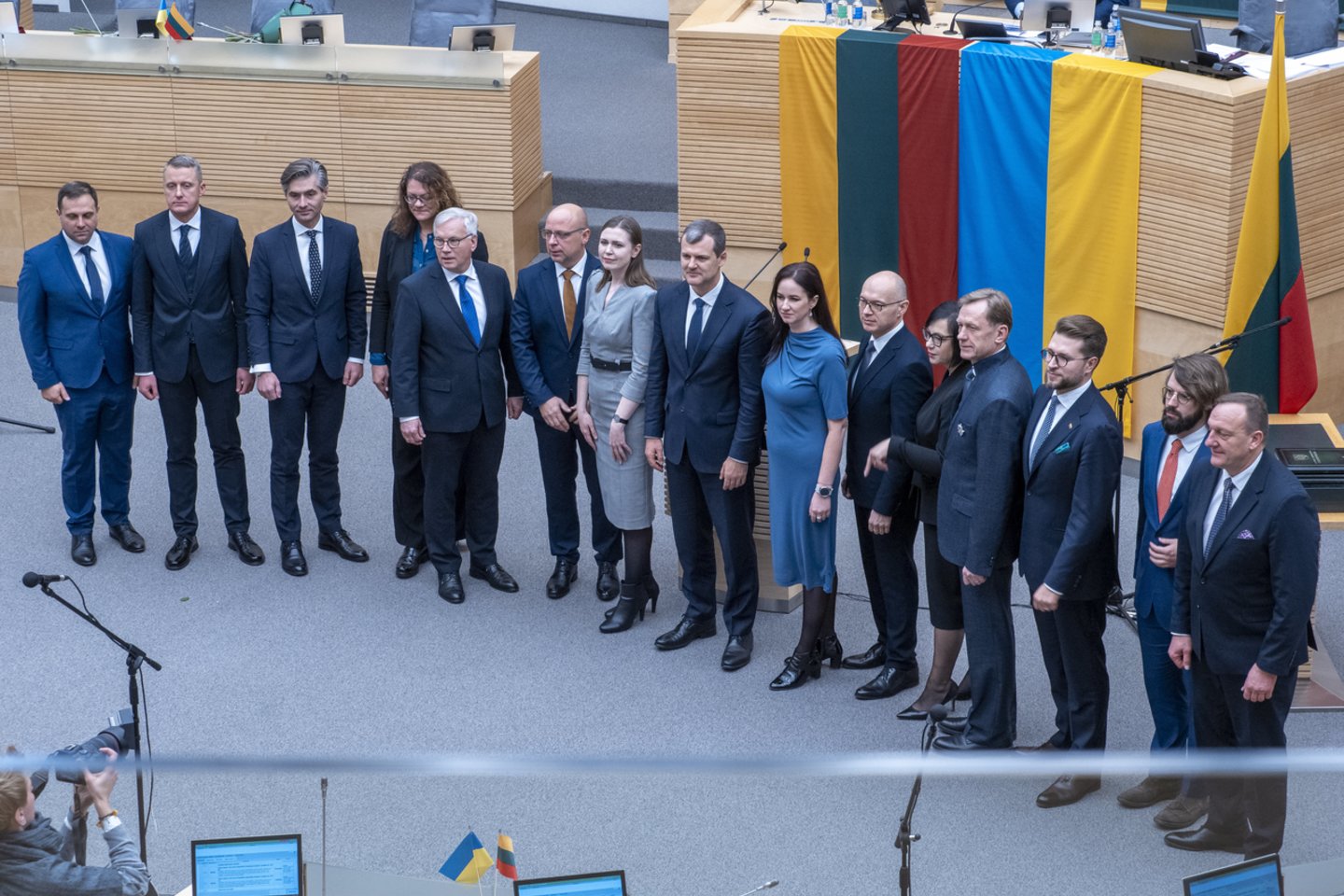
This will be the last government meeting chaired by Paluckas.
Once the resolution is adopted, the incumbent prime minister will submit his letter of resignation to the Head of State. Once the latter signs the decree providing for this, the entire government will be dismissed.
The president will then be able to appoint one of the ministers as interim prime minister until a new Government is formed.
The praesidium of the ruling LSDP has decided on a candidate for prime minister, whose candidacy will have to be discussed with Nausėda. Once the candidate has been selected, the head of state will submit it to the Seimas.
In turn, parliamentarians will have to decide on the new prime minister within one week after his presentation in the plenary session hall.
The Seimas votes openly on the candidate for prime minister – a simple majority is sufficient to approve the candidate.
Suppose the parliament approves the candidate for prime minister. In that case, they must, within 15 days of their appointment, present to the parliament a cabinet of ministers formed and approved by the president and submit the Government's Program for consideration. The Government is empowered to act when the Seimas approves its program by a majority vote of the members present at the session.
However, if the Cabinet resigns, the president will have the opportunity to reshuffle its composition. Thus, the ruling coalition may need to replace some or all of its ministers.
Currently, Povilas Poderskis is the Minister of the Environment, Rimantas Mockus is the Minister of Justice, and Ignas Hofmanas is the Minister of Agriculture. Nemuno Aušra delegates all three ministers under the coalition agreement.
Lukas Savickas, a member of the Democrats for Lithuania, holds the portfolio of Minister of Economy and Innovation, while Žygimantas Vaičiūnas is Minister of Energy.
The Social Democrats hold the other nine ministries. The Ministry of Culture is headed by Šarūnas Birutis, Foreign Affairs by Kęstutis Budrys, Health by Marija Jakubauskienė, Internal Affairs by Vladislavas Kondratrovičius, Education, Science and Sport by Raminta Popovienė, Social Security and Labour by Inga Ruginienė, Transport by Eugenijus Sabutis, Finance by Rimantas Šadžius, and National Defence by Dovilė Šakalienė.
The president has not yet expressed his position on whether he would like to see changes in the current government.