
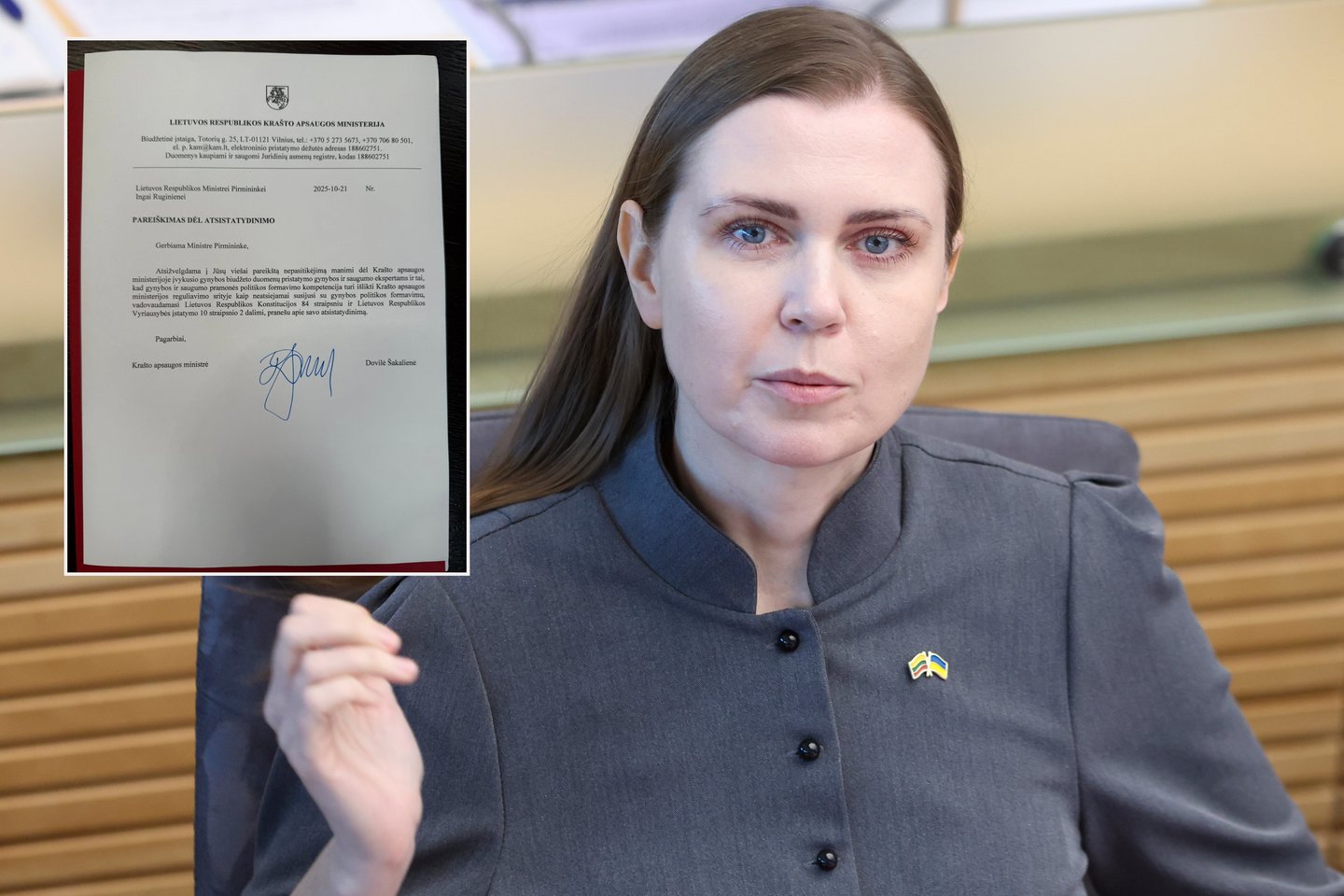
On Monday, after meeting with Prime Minister Inga Ruginienė, Šakalienė stated that in the summer, the Ministry of Finance proposed a budget to the Ministry of National Defence that did not even reach 4% of GDP. On October 1, it presented a budget that did not get 5% of GDP. On Wednesday, after resigning from her position, Šakalienė presented documents proving these words – correspondence between representatives of the ministries.
On Wednesday, after stepping down from her position, Šakalienė presented documents proving her words – correspondence between representatives of the ministries.
The documents show that in July, it was considered to allocate 3.36% of GDP, or EUR 2.9 billion, to defence funding for the following year.
At the same time, another document, which was to be presented by the new finance minister at the beginning of October, shows that the planned appropriations for the Ministry of National Defence (including the State Defence Fund) for 2026 are 4.87% of GDP, or EUR 4.3 billion, with an additional EUR 155 million earmarked for „other appropriations administrators' defence expenditures.“ The total planned expenditure is 5% of GDP.
Šakalienė also published e-mails showing that on October 14, at 7 p.m., the Ministry of Finance urgently requested the Ministry of National Defence to submit a proposal for additional increases in the Ministry of National Defence's appropriations for property.
It was on October 14 that messages from commentators, who were likely to have participated in the famous conversation at the ministry, were published on social networks about the insufficiently planned funding for defence.
On Monday, Ruginienė herself, explaining the situation, said that Šakalienė had misread the draft budget.
„When it comes to the budget, it all depends on how you read it. If the same amount is spread over several lines, you can take only one line and subtract it to get the total amount, or you can do what we did with the finance minister to ensure complete clarity: we put the entire budget in one line so that there would be no doubt.
If someone has had problems reading and seeing those numbers, we need to clarify such things internally, and the Minister of Finance is always open to explaining and saying so. I do not believe that the entire amount was visible at the technical level,“ said Ruginienė at the time.
For her part, Šakalienė emphasised on Wednesday that she and Ruginienė's understanding of what defence funding is—the prime minister understands defence, as she herself stated, in a broad sense, so defence funding could also cover, for example, roads and bridges.
At the same time, Šakalienė is convinced that the defence budget is primarily for defence needs and military acquisitions, and that the Ministry of National Defence budget cannot be a „basket from which anyone who wants to can come and take what they want.“
The scandal arose after it became clear that the Ministry of National Defence had held an unofficial meeting with public figures and influencers, during which information about lower-than-necessary defence funding was disclosed.
Although Šakalienė claimed that she knew nothing about this meeting, she was nevertheless pleased that it took place, as it resulted in securing greater funding for defence – 5.38% of GDP. However, according to the minister, even this amount would not be sufficient to meet all the needs of the army.
All correspondence published by Šakalienė can be found in the photo gallery.