
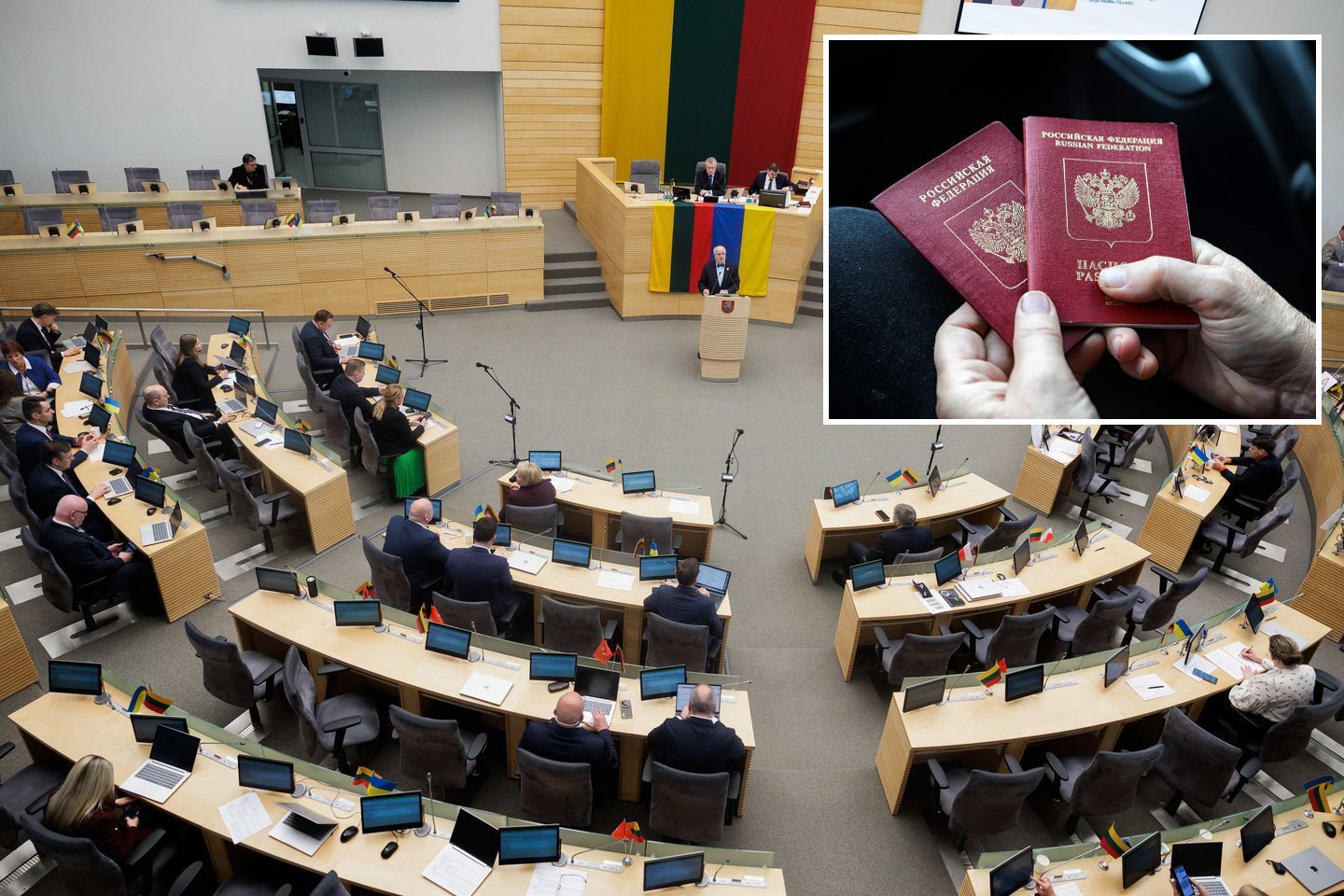
At the Social Democrats' request, this issue was removed from the agenda of Thursday's Seimas plenary session. As emphasised by Julius Sabatauskas, Chairman of the Seimas Committee on Legal Affairs and Law Enforcement, the exclusive right to submit such a bill is granted to the Government.
„The Seimas is bound not only by the Constitution, but also by the laws it has passed. According to the International Sanctions Act, the Government has the exclusive right to submit such a bill. I understand that 15 members of the Seimas have signed the bill. This is a symbolic number, as it equals the number of Government members, but it is not a bill of the current Government. Despite possibly good proposals and good content, they may end up in another bill,“ Sabatauskas said at the Seimas session.
His proposal to remove the Conservative initiative from Thursday's agenda was supported by 68 Seimas members, with 27 against and 10 abstaining.
Susiję straipsniai
On Thursday, Mindaugas Lingė, deputy leader of the opposition Homeland Union-Lithuanian Christian Democrats (TS-LKD) faction, intended to submit amendments to the Seimas proposing to tighten the conditions for Russian and Belarusian citizens to purchase real estate in Lithuania.
It planned to propose to parliamentarians to prohibit Russian and Belarusian citizens from buying real estate near military training grounds and other strategically important objects, ELTA reports.
An additional safeguard would be provided for those wishing to settle near such sites: only Russian and Belarusian citizens who have obtained the Lithuanian authorities' consent and hold a permanent residence permit in Lithuania would be able to purchase such real estate.
If the Seimas approves the bill, only Russian and Belarusian citizens with a valid permanent residence permit would be able to purchase real estate in Lithuania. Citizens of these countries with a temporary residence permit in our country would not have this opportunity.
According to Lingė, real estate purchased by citizens of unfriendly countries could be used for various hostile activities, including as a cover for long-term intelligence operations and for gathering information and other purposes.
Lingė claims that statistics show that Russian citizens in particular are actively buying property near strategic objects.
According to data from the Centre of Registers, Russian citizens acquired 2,814 real estate properties in Lithuania between 2022 and 2024, while Belarusian citizens acquired 1,834 properties.
The current law does not regulate the right of Russian and Belarusian citizens to purchase real estate located near objects important to national security or military training grounds.