
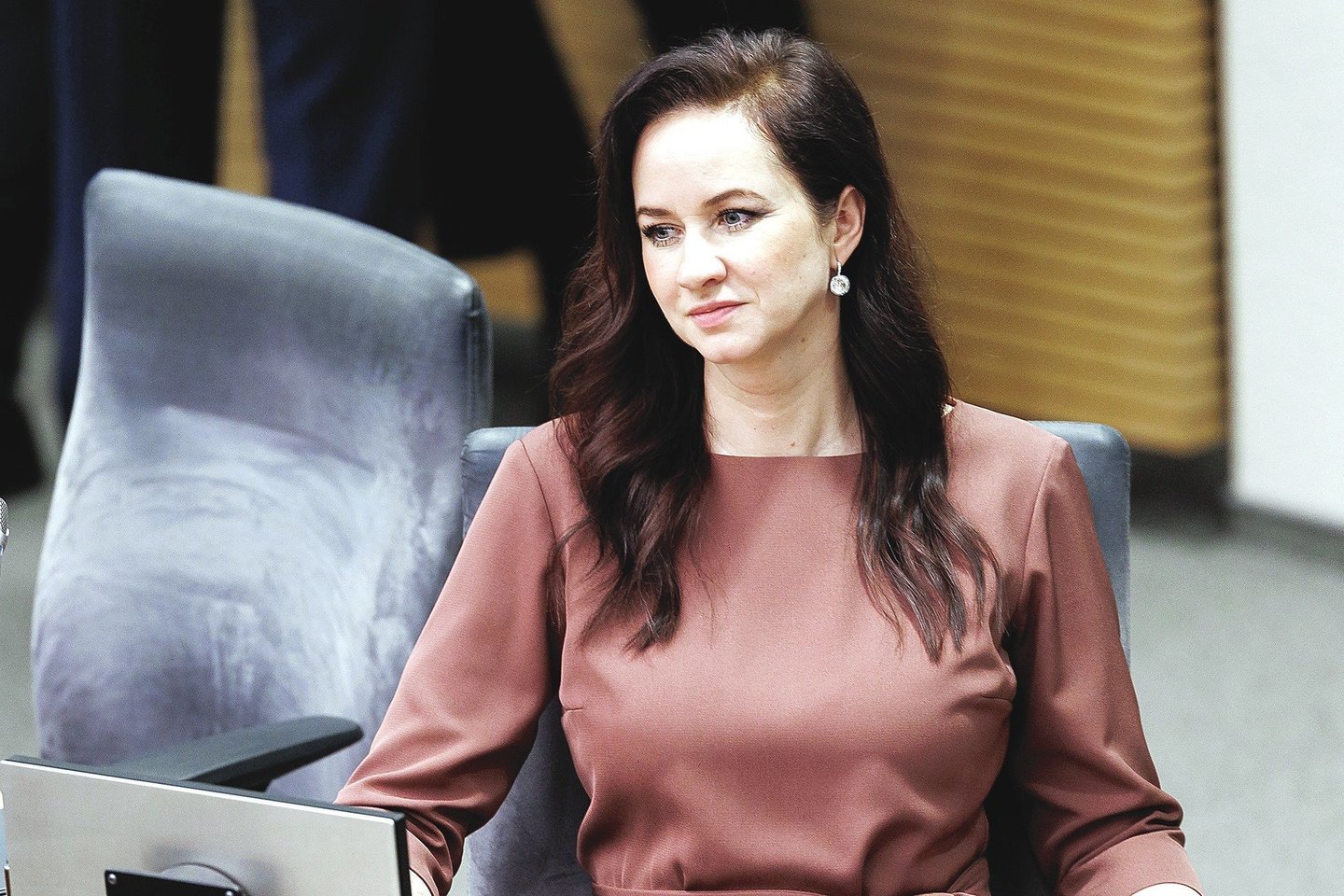
Ruginienė explained that the cabinet of ministers is currently focused on day-to-day work and decision-making.
„We are devoting a lot of attention to analysing the situation. Just today, together with the minister of transport and communications, we announced to the public that the government is consistently working to alleviate the hardships people are facing today. We are focused on our work. Today, we would like to talk about that work,“ Ruginienė told reporters at the government on Tuesday.
After Prime Minister Ruginienė stated that she could „perfectly participate“ in the EVT, the presidency told ELTA on Monday that such possibilities are not being considered.
„There are no discussions on the issue you mentioned because there is no subject for discussion,“ representatives of the presidential office stated in their response.
Meanwhile, the president's chief advisor, Asta Skaisgirytė, told Žinių Radijas on Tuesday that she saw no possibility of the head of government attending even some of these European meetings. When asked whether Ruginienė could attend at least some of the European Council meetings, the president’s advisor replied: „To put it bluntly—no.“
Ruginienė has no doubts about her competence
In an interview with the news portal Lrytas last week, Ruginienė said she has no doubts about her competence to participate in EVT meetings. According to her, it would be possible to reach a compromise between the presidency and the government on who—the president or herself—should assume this responsibility.
„It would be wonderful if we had that old system where responsibilities could be shared based on expertise. I believe we would certainly agree and have divided the responsibilities. Unfortunately, at the European level, there is now a completely new system in which such divisions are no longer possible. And that may well be the problem. But this does not depend on our decisions; those decisions are made at a much higher level,“ she emphasised.
Last October, the prime minister's advisor, Ignas Dobrovolskas, stated that the president and the prime minister had agreed to consult regularly on who should represent Lithuania at EEC meetings. At the time, he also said that the possibility of the prime minister participating in informal EEC meetings was not ruled out.
ELTA notes that discussions regarding representation at the EUC continued throughout the previous term of the Seimas. Dissatisfied with the current arrangement, the Conservatives urged that the head of government also be allowed to represent Lithuania in this European forum, depending on the topics discussed by EU leaders. However, the president called these initiatives intolerable and unacceptable.
It was proposed to resolve this issue by passing a law regulating representation at the European Council. However, the ruling coalition later backed away from this initiative.
Gintautas Paluckas, who served as Prime Minister, saw no need to change the existing procedure for representation at the European Council.
The European Council consists of the heads of state or government of the European Union (EU) member states, the President of the European Council, the President of the European Commission, and the EU High Representative for Foreign Affairs and Security Policy.
Council meetings are held at least twice every six months in Brussels. Extraordinary meetings are organised by separate agreement.
Would like to meet with Trump or Vance
The news portal Delfi, citing sources, reported last week that Ruginienė had tasked Budrys with organising a meeting with U.S. President Trump or Vice President Vance.
Foreign Minister’s Advisor Kristina Belikova neither confirmed nor denied this information in a comment to the portal.
Meanwhile, the prime minister’s advisor, Ignas Dobrovolskas, told the portal that a visit to the U.S. is not currently planned.
Deividas Matulionis, Chief Advisor to President Gitanas Nausėda, told LRT television that the President’s Office has not been informed of any such plans.
Matulionis stated that it would be excellent if both the prime minister and President Nausėda were to hold bilateral meetings with the White House occupant.
Meanwhile, the president’s advisor, Asta Skaisgirytė, told Žinių Radijas on Tuesday that the presidency is already trying to arrange a meeting with the U.S. leader. However, she emphasised that when travelling to Washington, it is necessary to have prepared proposals for bilateral agreements that Lithuania could present to the Americans.
Recently, the prime minister has been actively involved in foreign policy, an area typically overseen by the president and the foreign minister. Ruginienė herself has previously stated that she is interested in this field.