
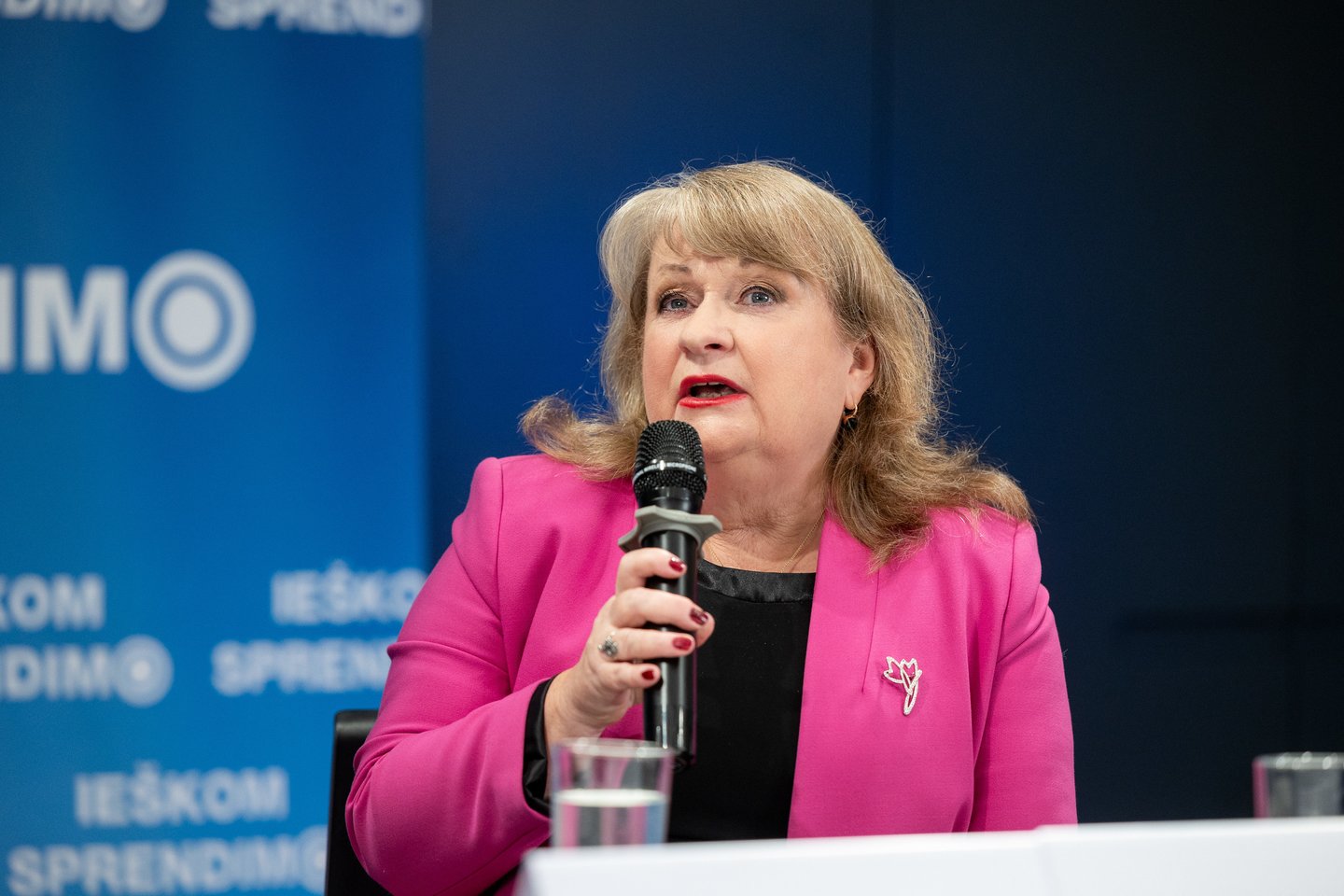
According to attorney Prof. Liudvika Meškauskaitė, the advisory referendum on the definition of the family has nothing to do with EU obligations. Therefore, in her opinion, such scare tactics are simply unfounded.
„These scare tactics stem from fear of one’s own people. If consulting the people and listening to their will contradicts our international obligations, it means that you do not recognise that Lithuania is a democratic state; it means that you do not recognise Article „Right to Marriage,“ which clearly states that a man and a woman of marriageable age have the right to register their marriage and that such a marriage is registered in accordance with the national laws of the state. „When we joined the EU, we did not surrender our sovereignty to decide on the concept of marriage and family,“ said Meškauskaitė during a roundtable discussion held in the Seimas on Monday titled „Referendum on the Concept of Family in the Constitution: Will We Let the People Have Their Say?“
In her view, this is an existential issue, given Lithuania's drastically declining birth rate.
Susiję straipsniai
„I am deeply convinced that an advisory referendum could unite, rather than divide, the nation, as it is a civilised, transparent expression of the will of the people,“ she emphasised.
Lawyer Prof. Violeta Vasiliauskienė, who participated in the event, also stated that no international institution has the right to dictate to a sovereign nation how the family should be treated in its Constitution.
„The United Nations states that each country defines for itself what a family is. The European Court of Human Rights leaves this matter to national discretion. The EU has no jurisdiction in family law, and our own constitutional order grants supreme authority precisely to those to whom it belongs—the people of Lithuania. A referendum is simply a direct democratic response, implemented by that authority, to a question that we have always had to answer ourselves,“ said Vasiliauskienė.
Girskienė: The Constitutional Court granted itself the right to „rewrite“ the Constitution
According to Seimas member Ligita Girskienė, a member of the Peasants’ Party who participated in the discussion, last April the Constitutional Court (KT), in interpreting the provisions of Article 38 of the Constitution, granted itself the right to „rewrite“ the Constitution and give it a broader and more modern content.
„Such a broad and modern interpretation, which the Nation did not clearly establish when adopting the Constitution in 1992. Critics of the idea of holding a referendum explain that the Nation adopted the text, not a narrow interpretation. The text of the Constitution does not state that family = only marriage. The Court merely reveals the true meaning of the provision. Can the Constitutional Court „reveal the true meaning of the provision“ in such a way that its meaning would fundamentally change? Unequivocally—no,“ argues Girskienė.
According to her, the Constitutional Court cannot create content „out of thin air,“ merely on its own will and the personal views of its judges, or on the case law established by foreign courts.
„It must be guided by the text of the Constitution, its previous doctrine, general principles of law, and international obligations. However, international practice is a supplementary source, not superior to the Constitution; it helps ensure human rights and maintain compatibility with Europe. Courts sometimes rely too heavily on international practice, adopting ideas not clearly endorsed by the people. This may appear as „the importation of norms without a democratic mandate.“ This is precisely what happened with the Constitutional Court’s ruling of April 17, 2025,“ said Girskienė.
As reported, last April, the Constitutional Court ruled that the fact that same-sex partnerships are not legalised in Lithuania violates the country’s fundamental law. The Constitutional Court also declared unconstitutional the article of the Civil Code (CC) under which a partnership may be formed only between a man and a woman.
„If society disagrees with the court’s interpretation—as is the case here, where nearly 70 per cent of the people disagree with the expansion of the concept of family—it has the means to ‘rewrite’ it by amending the Constitution through a referendum and clearly establishing a different interpretation of the Constitution’s provisions. No one can take this away from the people right away. The people are the source of the Constitution. Article 9 of the Constitution provides that the most important issues concerning the life of the State and the people are decided by referendum. Amending the Constitution by referendum cannot contradict the Constitution,“ stated Girskienė.
The discussion held in the Seimas on Monday regarding the planned consultative referendum on the concept of the family was also attended by Seimas members Audronius Ažubalis and Vytautas Sinica, representatives of the academic community, constitutional law experts, and others.
As previously reported by ELTA, on April 9, the Seimas decided to consider a parliamentary group’s initiative to hold an advisory referendum on enshrining the concept of family in the Constitution alongside the 2027 municipal council and mayoral elections.
If the Seimas approves the initiative, citizens would be asked in the advisory referendum whether they agree that „the Constitution should explicitly state that legal family relationships arise solely from the marriage of a man and a woman, and from motherhood and fatherhood.“
As noted in the draft resolution submitted by Vytautas Sinica, a member of the Mixed Group of Seimas Members, the family is the foundation of society and the state, and the sustainability and continuity of both depend on its preservation. In its document, the Seimas intends to reiterate that „the complementarity of man and woman is the foundation for the creation of the family as the primary and natural community and the most favourable environment for a child’s growth, development, and upbringing.“
The draft resolution also emphasises the right of citizens to directly decide on the most important issues for the state, which may affect the quality of life of current and future generations, as well as the very survival of the Nation.
More than 60 members of parliament from various parliamentary factions are proposing to hold an advisory referendum on amending Article 38 of the Constitution.
An advisory referendum is considered valid if more than half of the eligible registered voters participate. If at least half of the citizens who participated in the referendum approved the decision put to a vote, the Seimas must consider implementing their expressed will no later than one month after the final results of the referendum are announced.