
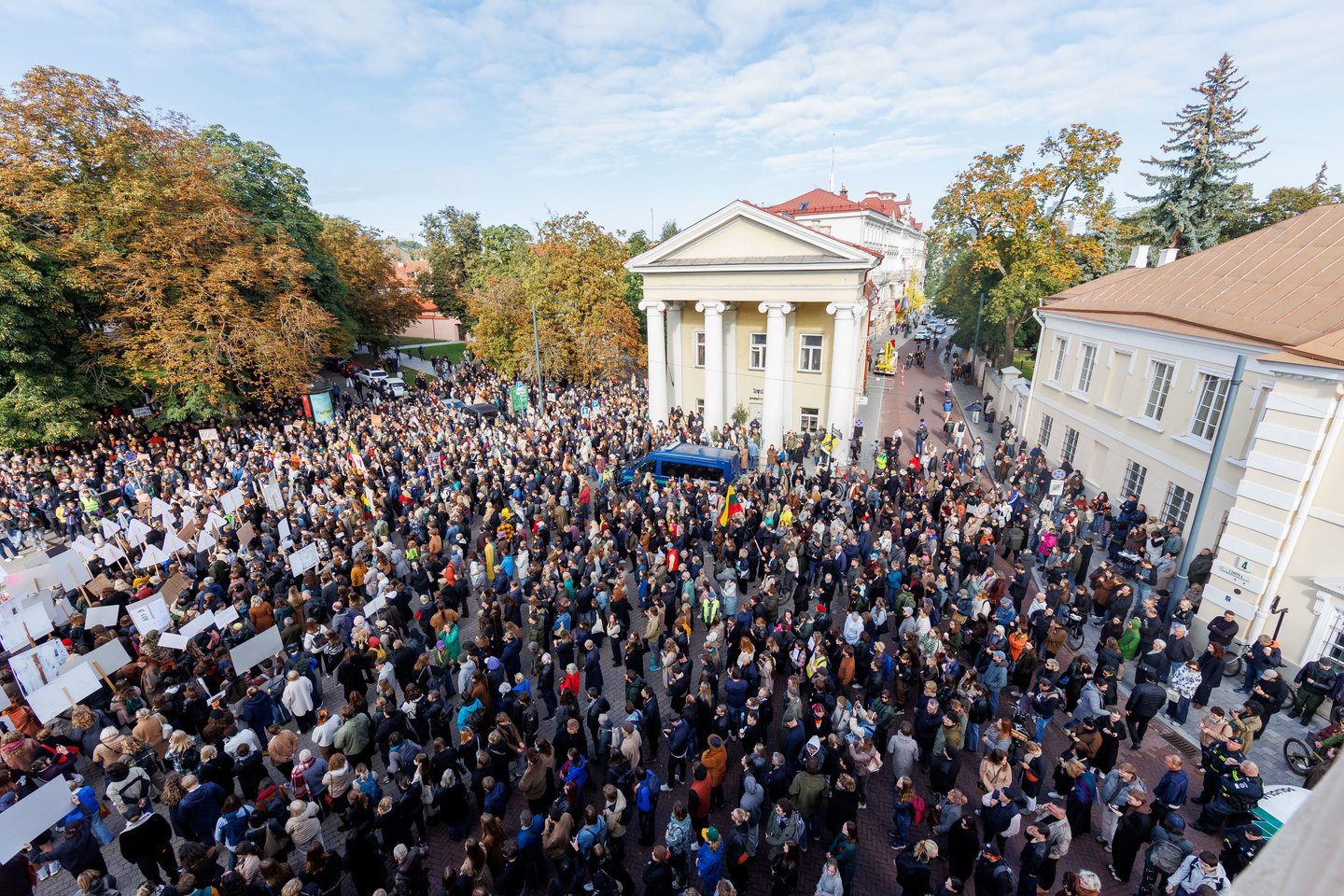
In total, since September 25, when the first reports of plans to appoint Ignotas Adomavičius appeared, foreign media outlets have published more than 100 articles describing reactions to the appointment of the minister of culture. Most of the articles were published in Latvia, with 24 publications about Adomavičius, followed by Russia with 22, Estonia with 9, and Poland with 5. It was also noted that 38 publications appeared on Telegram channels, mainly in Russian.
„Foreign portals were dominated by neutral or critical reports on the situation: they wrote about mass protests by cultural workers and public statements by the minister. For example, it was mentioned that hundreds of artists and cultural figures gathered at the Presidential Palace to protest against the appointment of Adomavičius,“ Vilūnė Kairienė, data strategist at Mediaskopas, told ELTA.
It is noted that the Latvian, Estonian, and Russian media covered the appointment of the new culture minister differently. Still, all reports were united by a critical tone that formed an unfavourable image of Lithuania.
„All three cases create a negative image of Lithuania, but using different means: from reasoned criticism to sensational dramatisation to propaganda-style disparagement,“ Kairienė points out.
Latvian media focused mainly on the reaction of the cultural community.
The Latvian media primarily focused on the reaction of the cultural community to Adomavičius' appointment, highlighting artists' protests, petitions, and plans for strikes, while also quoting emotional phrases about „cynical contempt for culture“ and „betrayal of democracy.“
„The decision by the Vilnius Book Fair and the Scanorama film festival to refuse the support of President Gitanas Nausėda has been interpreted in the Latvian media as a precedent in which the cultural community clearly distances itself from politics. This has created a well-argued narrative in Latvia: the minister's appointment is being criticised and Adomavičius's lack of experience is being emphasised,“ says Kairienė.
In the Estonian media, Ruginienė's government is portrayed as weak
For its part, the Estonian press further amplified the appointment of Adomavičius and the reactions it provoked. Instead of restrained criticism, dramatised descriptions dominated – there were reports of an international scandal, a wall of shame, boycotts, and mass protests.
Protest against Adomavičius' appointment as minister outside the Presidential Palace: an angry crowd was captured on camera
„Such rhetoric reinforced the impression that Lithuania is not only experiencing internal conflict, but also an international reputation crisis. Ruginienė's Government is portrayed in Estonian texts as weak and shaken by conflict, and Adomavičius' appointment as a symbol that threatens the country's prestige abroad,“ said Kairienė.
Russia constructs an image of an unstable Lithuania
At the time, the Russian media presented the Adomavičius scandal in a biased manner, disparaging Lithuania. The facts of the protests, petitions, and artists' actions were not distorted; however, the messages were arranged in a way that created the most unfavourable image of Lithuania possible.
„The articles repeatedly claimed that President Gitanas Nausėda had 'violated the Constitution' by interfering in the formation of the coalition, while Adomavičius was portrayed as an inexperienced and controversial politician whose appointment symbolised the incompetence of the government. Even artists' performances, which were actually intended to express protest, were used as metaphors for chaos and disorder,“ says Kairienė.
„This creates a broader narrative in which not only the minister of culture but also the entire Lithuanian government is portrayed as weak, having lost its authority and become the object of international ridicule,“ she added.
In one publication by the Russian news agency TASS, the protests against Adomavičius are presented as a massive, almost uncontrollable „chain reaction“ – a metaphor that creates the illusion that the entire cultural community has unanimously refused to cooperate with the government.
„In this way, the factual information is not denied, but it is intertwined with a hyperbolic narrative that reinforces the impression that Lithuania is in the midst of a systemic crisis. This is typical of Russian media tactics: without verifying the facts, but choosing vivid, emotional metaphors and dramatic formulations that allow the reader to believe that Lithuania is sinking into chaos,“ notes the Mediaskopas data strategist.
ELTA recalls that last week, when the country's leader appointed Ignotas Adomavičius, a member of the Nemuno Aušra newspaper, as the new minister of culture, a wave of indignation arose – questions were raised about the politician's competence. The minister's statement after the meeting with the president was also criticised.
Last week, a protest was held in Simonas Daukantas Square near the Presidential Palace, with around a thousand representatives of the cultural sector demanding that the institution not remain in the hands of Nemuno Aušra. Cultural figures are also circulating a petition, which has already garnered over 62,000 signatures.
On Sunday, October 5, artists are organising a warning strike.