
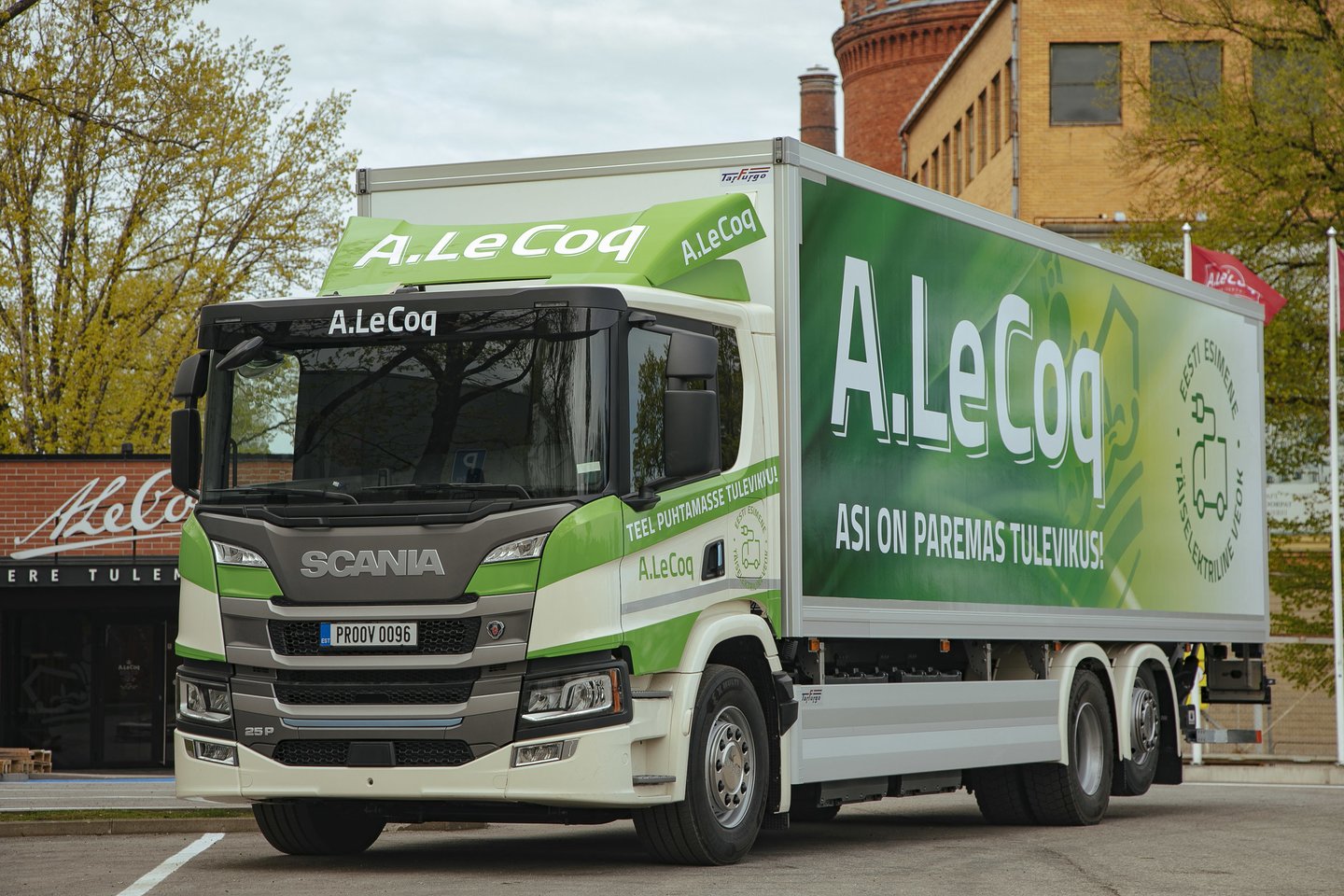
The head of Scania Eesti, Janno Karu, says that this is the first electric lorry on Estonian roads but their number will increase over the coming years. Scania's goal is to have electric lorries account for 10% of new sales by 2025, and to have half of the new vehicles produced be electric by 2030. „These goals are tied to the objectives of the Paris Climate Agreement. To mitigate the effects of climate change globally, we need to halve our CO₂ footprint every 10 years, and the electrification of rolling stock is one way of doing that.“ He added that Scania became the world's first heavy vehicle producer that has set science-based goals to lower greenhouse gas production in its production processes.
According to Karu, there are three main obstacles to the green transition in the road transport business. „An electric vehicle is almost twice as expensive as a diesel vehicle, which makes it out of reach for many road transportation companies. Secondly, there are not enough charging places or capacity on roads. The third aspect is that more green energy production capacity is needed. Solving these three issues requires support from the government and the EU.“
He added that the advantages of an electric vehicle are most apparent when it is charged using green renewable energy, in which case the vehicle's footprint (wheel-to-wheel) is up to 99% lower than that of a diesel vehicle.
The curator of green transition in Estonia Kristi Klaas says that the transportation sector accounts for around 17% of overall greenhouse gas emissions. „Reducing emissions in the transportation sector is a challenge for the EU and Estonia as we need to lower emissions in the transportation and agriculture sectors by 13% by 2030; the target will probably rise to 24% after the new climate package negotiations.“
She added that the target would be reached using three methods: the public sector's example when acquiring vehicles, infrastructure that supports environmentally friendly cars and the interest and initiative of the private sector. „From this summer, the public sector and government institutions will only acquire environmentally friendly buses, lorries and cars. Charging infrastructure is another challenge, and the EU is currently negotiating at which intervals charging stations need to be placed across the EU. The initiative of the private sector is very welcomed since companies that care about the environment usually are trailblazers who boldly test new technologies and solutions, and hence guide the way for other companies.“
The head of A. Le Coq, Tarmo Noop, adds that this is the first vehicle that the company is buying itself, as transportation services are usually outsourced. „A regular transportation company cannot obtain electric vehicles due to their cost, which means that it is the client's wish that is instrumental in promoting environmentally friendly transport. Our wish is clear, which is why we obtained the vehicle and transferred it to our logistics partner to use. It also goes well with A. Le Coq’s green leap goals to leave the next generations a cleaner and better world,“ Noop said.
Noop also says that the price of an electric vehicle is two times higher than that of a diesel vehicle but it has more advantages in terms of energy efficiency and fuel consumption. „The cost of fossil fuels continues to rise but the more green energy is produced, the less each kilometre covered by the vehicle costs. Right now, the energy price per kilometre is a third cheaper than with diesel fuel,“ Noop clarified. A. Le Coq’s electric lorry (and the whole company) uses only renewable green energy.
Noop urges other companies to take the same steps and find solutions for carbon footprint reduction. „The private sector should lead the way and policy will follow,“ Noop says.
A. Le Coq’s electric lorry will transport goods around Tallinn. Because the vehicle lacks an internal combustion engine and an exhaust pipe, it lowers the noise and pollution levels in the city, ensuring the air is cleaner.
Scania Lietuva customers will be able to test this vehicle on June 3, during the first Baltic heavy transport electrification event in Riga.
Technical data of the electric lorry:
Length: 11.5 m
Axle spread: 5.75/1.35 m
Electricity consumption per km: ~1.3 kWh/km
Load capacity: 14,060 kg
Range: up to 250 km
Motor capacity: 230 kW
Add-ons: a trailer with a tail lift
Total weight of the vehicle: 29 t
Vehicle's battery capacity: 300 kWh