
„Although there are different opinions about fertilisers, they are nothing more than nutrients that feed the plants. The substances we commonly call fertilisers, such as nitrogen, phosphorus, potassium, magnesium, sulphur and others, are present in cereals. In a kilogram of grain, we would find about 40–46 grams of these substances, while in a hectare of plants, we would find about 700–800 kilograms of these substances,“ Šakys gives an example.
If a farmer wants to grow healthy plants and produce a good harvest, he needs to know how many of the various substances are in his soil. If the soil is deficient, fertilisation is recommended.
„Of course, this is the choice of each farmer, but to put it simply, without fertilisers, the yield will be so low that the farmer's work will not pay off. If fertiliser is applied following the recommendations, if the Green Deal is followed, healthy plants grow and produce healthy food for people,“ explains the head of Agrokoncernas.
He points out that it is not easy to obtain fertiliser at the moment. The energy crisis that followed Russia's invasion of Ukraine has also affected the agricultural sector. Nitrogenous fertilisers are produced with the help of gas, which is extremely expensive. Many nitrogen fertiliser plants in the European Union are currently shut down, which is a cause of great concern for farmers.
„Another challenge is that fertilisers are heavy, so transport is also a very important cost factor. Fertilisers such as potassium and phosphorus fertilisers are produced in few places in the world, so they have to be shipped to Lithuania, unloaded, packed and transported to warehouses. The fertiliser trade is a long, labour-intensive and resource-intensive job, which has an impact on fertiliser prices,“ says Šakys.
For this reason, the company invests heavily in science. „AgroITC, Agrokoncerno's research arm, conducts a range of studies with the main aim of finding out how reducing the amount of fertiliser can lead to a healthy and complete harvest. Different crop production strategies are tested in a certified laboratory. This year, over two thousand fields were tested.
„As farmers ourselves, we only provide our customers with proven solutions. For example, this year alone, we have already carried out tens of thousands of different tests in our own laboratory, and we share the results with farmers. We also focus on technology, which is the future of precision farming,“ says the CEO.
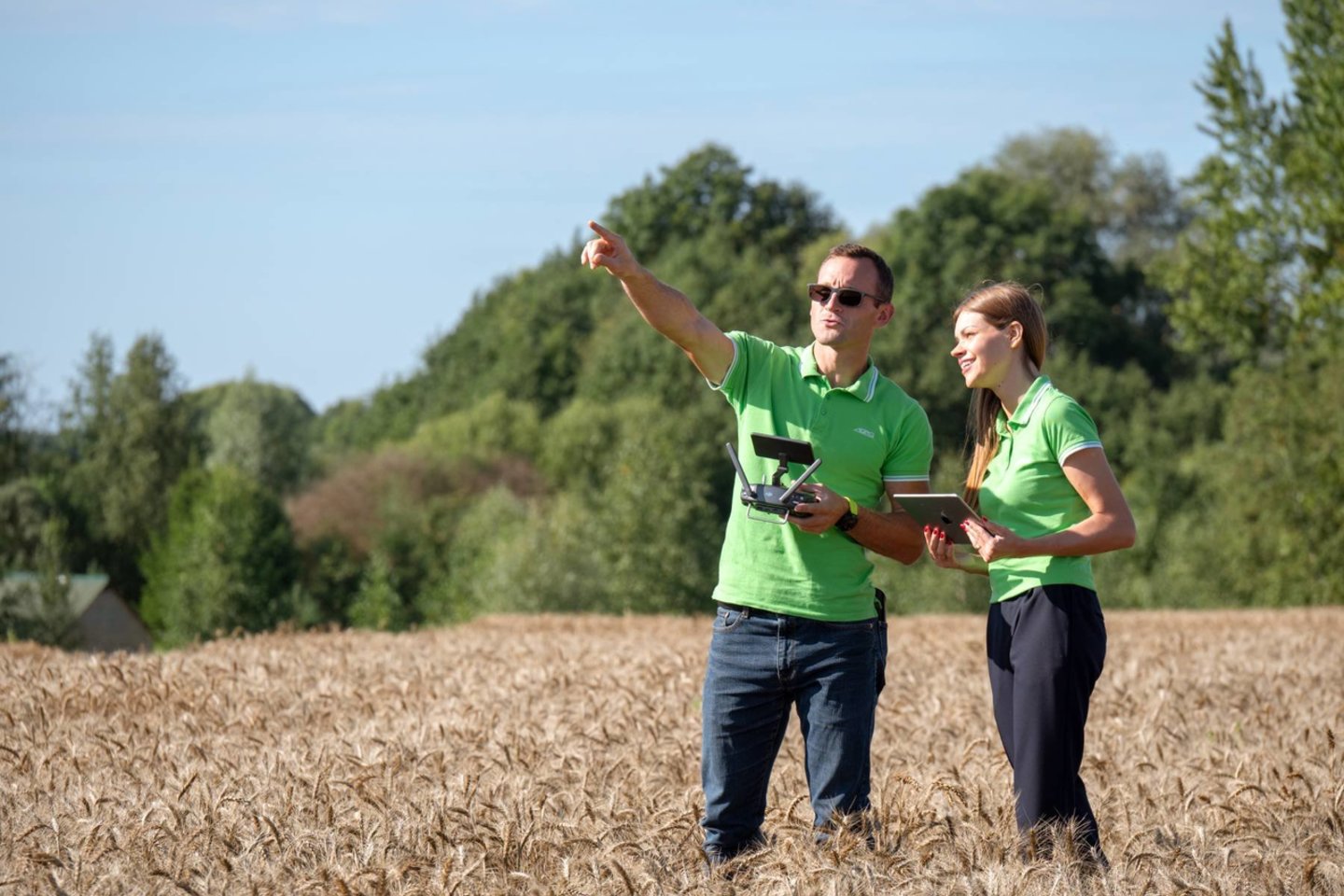
„The Agrokoncernas Group has set up an agricultural company, Future Farm, where the latest technologies are tested in production, i.e. in real farm conditions. This spring, for the first time, precision spraying was carried out, where the necessary materials were applied only where needed. This process involved the tractor's computer system, agro drones and intelligent sprayers. This rational spraying helps to significantly reduce the need for inputs and ensure a quality harvest.
„More and more farmers realise that, with such expensive fertilisers, it is necessary to take into account the fertiliser recommendations and new technologies on offer. Even though it is not an easy time, the majority of farmers are buying fertilisers for the next harvest because they understand that the supply of fertilisers is still difficult at the moment, and they do not know what the situation will be like in the future,“ said Šakys.
He recalls the spring turmoil when the fertiliser market was not as abundant as it needed to be. „Agrokoncernas was one of the first groups to completely cut off business relations with the aggressor countries Russia and Belarus. Despite the time and effort required, the company has established links with fertiliser suppliers in the West and is focusing on technological solutions to address the challenges facing the agricultural sector and, above all, to achieve the ultimate goal of ensuring a quality harvest.