
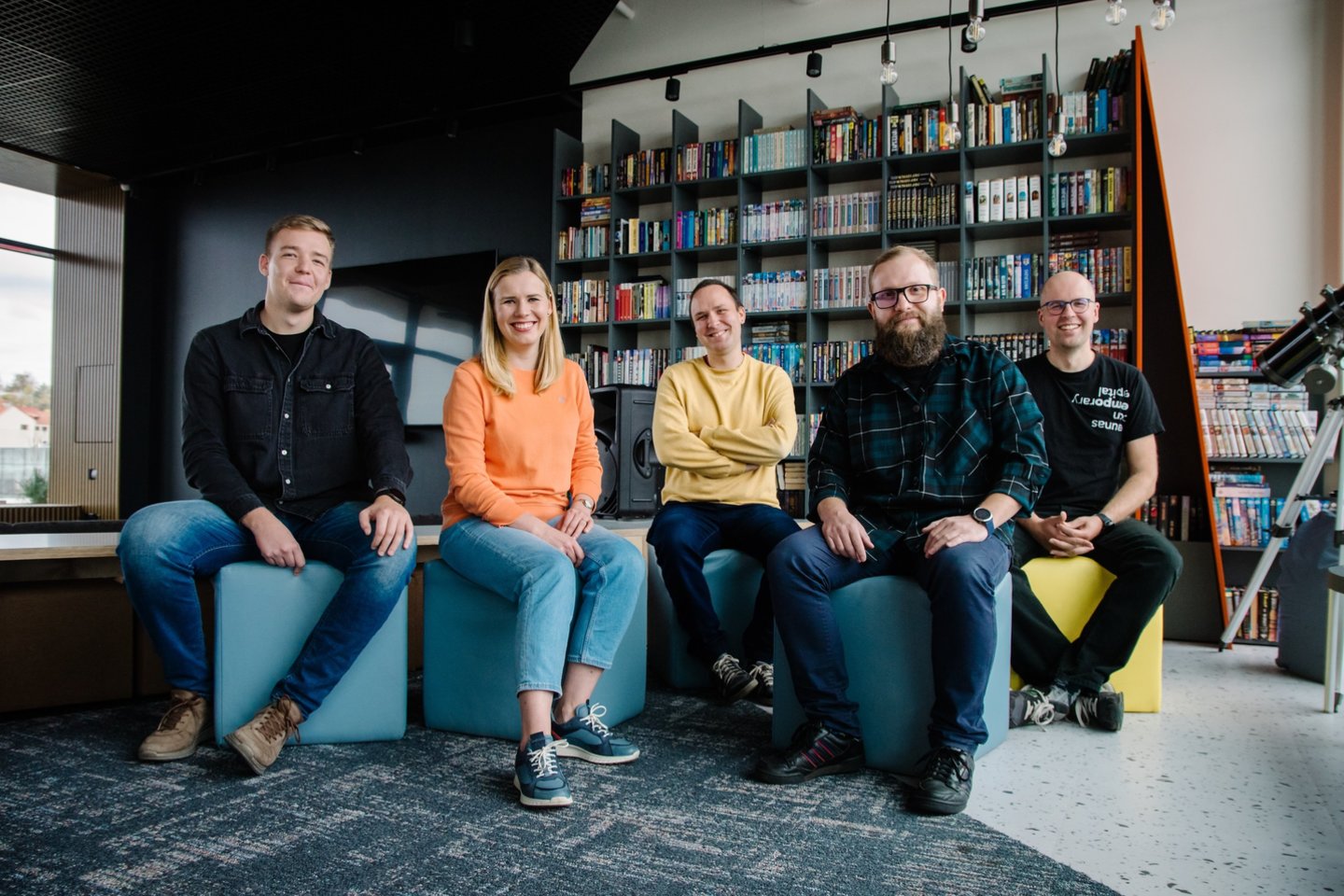
The Lithuanian startup is taking its first steps in the market. Nonetheless, its services are already being employed by well-known local companies such as Sanitex, Audimas, and Pegasas. And those are just some of LupaSearch's existing clients.
R. Šiškutė is confident the startup will achieve even greater success abroad, thanks to its advanced search technology based on AI, which is poised to quickly replace outdated keyword search systems. These seams aren't just empty promises; the startup is currently in advanced negotiations with several large global companies.
Predicting the user's needs and wants
To enhance the user experience and boost customer sales, LupaSearch employs AI and natural language processing (NLP) solutions. These solutions consist of vector search models that allow searches based on word vectors and product images. In addition, the AI creates graphs of synonyms and related words, working on principles similar to those used in knowledge graphs. This makes it possible to identify synonyms in various fields without manual input.
During a conversation about search engine functionality and the importance of personalization in identifying needs based on previous searches, the co-founder of LupaSearch draws a comparison to Google.
„Think about how the consumer search experience changed when everyone started getting different search results on Google using the same keywords. Once search starts to understand where you come from, what you were interested in before, and what you bought, it becomes much easier to identify what you need,“ R. Šiškutė emphasized.
She cited an experiment that demonstrated that by tracking and analyzing an individual's location coordinates over a period of several months, it is possible to predict with 99% accuracy their exact location and time of arrival for the following day.
„We are all surprisingly predictable, often visiting the same places, taking the same routes. That's why researchers have been able to predict the location of individuals to the exact minute,“ explained LupaSearch CEO.
She stated that personalization can be applied using various operating principles and can be beneficial for a range of purposes, but it is most effective in e-commerce. Its main objective is to enhance the customer experience and offer products, services, and combinations relevant to their needs.
To emphasize the importance of building a relationship with clients, R. Šiškutė uses a relatable example from everyday life:
„Imagine coming to a café where the barista greets you warmly, asks you if you will have the same coffee as always, and then outlines in detail what it will be. All you have to do is accept. A similar process is already taking place in the digital realm. We predict the context – what the customer is looking for, what they are interested in. Accurately anticipating the customer's request is the key to success and creating a connection and, ultimately, a transaction. After all, typing „pizza margherita“ is easier than listing all ingredients,“ explained the LupaSearch manager.
Not sure? Let's compare
R. Šiškutė has identified four aspects that are key to the success of the LupaSearch system: advanced data benchmarking, accurate data collection and collation, technological superiority, and rapid change in the e-commerce industry.
According to the startup's CEO, by leveraging the latest software code libraries, algorithms, methods, and subsystems, LupaSearch has offered its customers search solutions that not only analyze the collected data in detail but also personalize the search according to the specific visitor's behavior and needs, ultimately leading to higher conversions.
„Our system integrates the latest technological advances, such as Chat GPT and CLIP, which means customers get the most advanced experience when searching on a website or in an e-shop. The artificial intelligence models we use give us a huge advantage over other players in the market, whose technical platforms are largely outdated and out of step with the capabilities of modern times and the needs of businesses,“ emphasized R. Šiškutė.
The startup's CEO has expressed that she and her colleagues value the „let's compare apples with apples“ principle. However, she admits that comparing search engine pricing for e-commerce managers is incredibly difficult, and comparing the data provided by these systems is even more challenging.
„It is a very complicated task when existing e-commerce managers end up monitoring users of trading platforms. The widely used Google Analytics 4 (GA4) tool is exceptionally complex, and so we try to show our clients the real picture as clearly as possible and help them break out of the realm of distorted mirrors,“ says R. Šiškutė.
LupaSearch assists e-commerce professionals by providing benchmarking to understand startups' solutions in the overall market context objectively.
„We encourage our potential clients, with no obligation on their part, to share their e-commerce data with us. This data is crucial in providing them with a realistic search experience by inserting it into our internal system. We use A/B testing environments to ensure the best results, especially for enterprise-level clients. With this approach, our search engine and other systems can run simultaneously, and the search traffic launched amongst multiple groups can be compared and monitored. This allows us to identify which search system is performing better in terms of conversion rates. Additionally, we have developed a User Journey Flow function, which enables us to analyze user behavior and compare it with previous data. This helps us to improve the overall search experience for our clients“, explains the LupaSearch leader on how their company makes things easier for potential clients.
Improved results for all customers
Although everything may seem impressive, R. Šiškutė says the devil is in the details. Even the most sophisticated trade processes need constant improvement and should not be left unattended.
According to R. Šiškutė, there are a lot of small, hard-to-see details that need a particular kind of attention. LupaSearch calls this anomaly search.
„Sales conversion requires personal attention – just like a physical object in real life. A manufactured car can be of very high quality but deteriorate quickly if it is not constantly maintained. The same processes apply to our line of work. Many search providers integrate new customers into their systems only to forget them soon. We understand that good results require continuous work. Search is a living organism that needs constant care. And, to make sure that we are dead serious about our work and goals, we have a 5–10 thousand Euros reimbursement fee in case we do not deliver upon agreed results,“ said R. Šiškutė about the nuances of working with clients.
During an interview, she highlighted several well-known Lithuanian companies, emphasizing that all of them had seen improvements in their sales results after adopting the LupaSearch AI-powered search engine.
„Without exception, all of our clients, including Pegasas, Lemona, Shipzee, Sanitex, Assorti, and others, who turned to us from various other search engines improved their results by an average of 20%,“ R. Šiškutė said.
Although the list of clients includes well-known large local companies, the startup's CEO emphasizes that their search model is also suitable for medium-sized and small businesses. LupaSearch has adjusted its pricing model and developed an appropriate API (application programming interface) and integration guidelines to meet small businesses' needs and capabilities.
Out into the world, but with a home country in their heart
Looking to the future, R. Šiškutė says that the startup's technologies should remain the same. That said, their capabilities will be developed, and improvements will be implemented, which will only serve as a sign of their commitment to their clients.
„LupaSearch is investing heavily in artificial intelligence and natural language processing technologies to understand user behavior better. This will allow us to deliver even more personalized results. We also plan to improve our ability to monitor users' behavior in real-time to react to changes immediately,“ says LupaSearch's CEO.
She also emphasizes that there will be continued investment in vector search technologies, making it easier to accurately identify the context of people's searches and provide them with more relevant results, even ones based on ambiguous, improper, or highly abstract search queries.
R. Šiškutė noted that one of the primary goals of the startup is geographical expansion.
„We have made solid first steps in Lithuania and established a dialogue with almost all the major players in the market. So now our eyes are turning to other markets. We plan to expand our activities and enter foreign markets, which should open doors to customers worldwide,“ said R. Šiškutė, adding that Lithuanian companies will continue receiving special attention as the startup grows.
„Whatever the case, this is our home market. Not only do we know it best, but we also feel obligated to contribute to its prosperity,“ the startup's CEO remarked.
LupaSearch is a newcomer to the market, but R. Šiškutė sees this as an advantage.
„Starting later allowed us to utilize the existing well-developed AI algorithms and techniques. That helps us grow faster and offer more effective solutions,“ underlines the co-founder and CEO of AI search engine LupaSearch.