
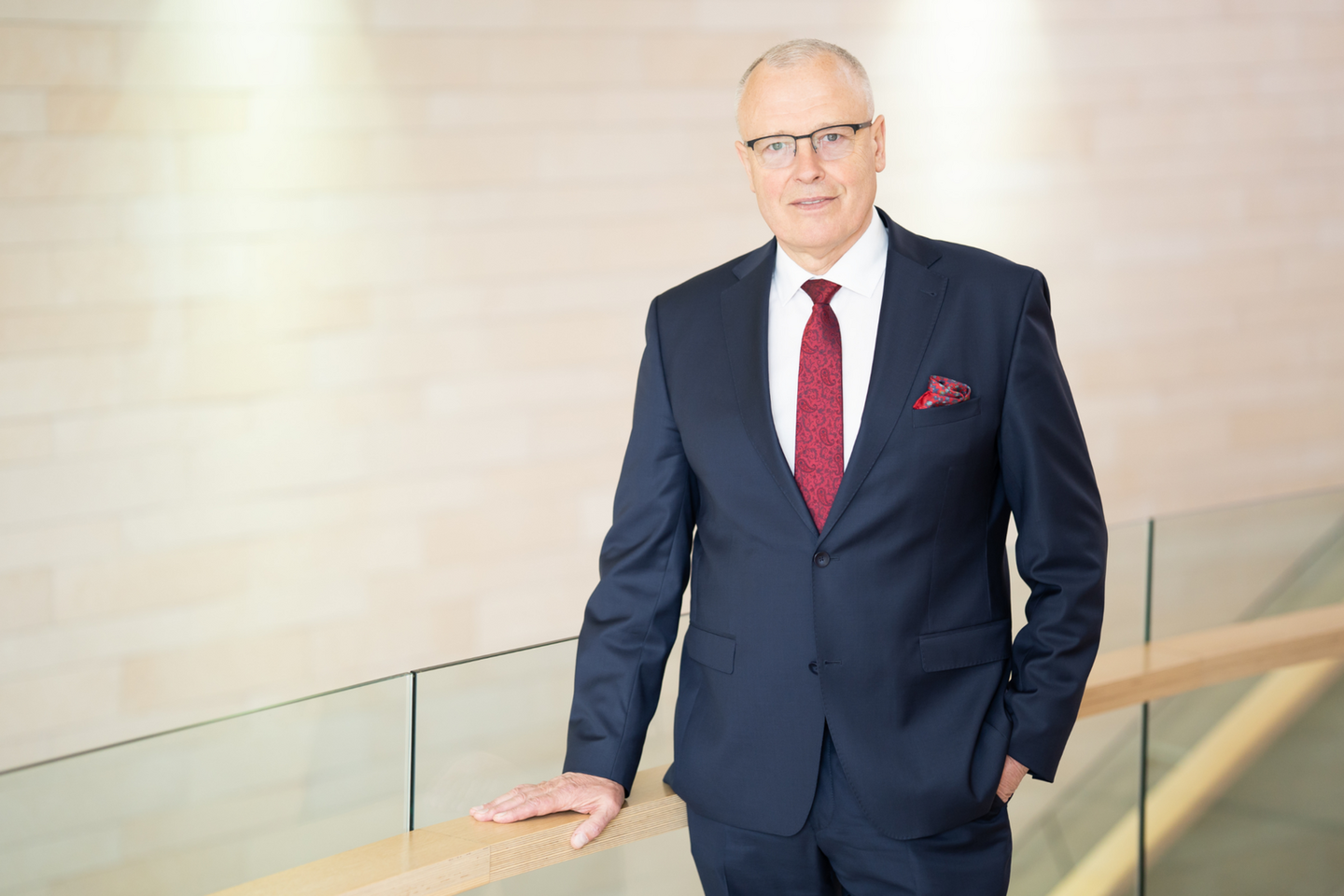
The project is also being supported by Klaipėda University alumnus, Civinity founder and Chairman of the Board, Deividas Jacka, who has donated EUR 10,000 to the Klaipėda University Future Support Fund. The total planned cost of acquiring the humanoid robot is approximately EUR 80,000.
According to the university, the new robot will enable researchers to enter the next stage of robotics development by testing artificial intelligence algorithms not only in digital models or laboratory systems, but also in a physical environment designed for humans.
„Partnerships between universities and businesses create the greatest value when students and researchers have the opportunity to work with technologies that are rapidly approaching practical application. As a graduate of Klaipėda University, it is important to me that these competencies continue to grow in Klaipėda. This is an investment in people, in the region’s ambitions and in solutions that businesses will be able to apply in the future,“ said Deividas Jacka.
Susiję straipsniai

From the laboratory to the real world
At Klaipėda University, robotics is being developed as a field that combines teaching, research and applied projects. The university’s robotics laboratory is already equipped with Fanuc collaborative robots, an ABB manipulator, as well as Dobot and SCARA systems. It will soon be expanded with a Delta-type robot and the already ordered Unitree Go2-W mobile hybrid robot.
The existing equipment is well suited to production lines, warehousing and other predefined operations. However, in real-world environments – such as ports, ships, construction sites, energy facilities or public spaces – conditions are often far less predictable. Robots must be able to move across uneven terrain, climb stairs, avoid obstacles and use tools designed for humans.
It is precisely for these kinds of tasks that a humanoid robot would be deployed. It would be capable of operating in environments fundamentally designed for people rather than specially adapted robotic systems.
„Until now, we have been able to develop and test advanced algorithms, but we have lacked a physical ‘executor’ capable of operating under unpredictable conditions. A humanoid robot would allow us to study not an idealised model, but the real world – with its imperfections, disruptions and constantly changing environment,“ said Associate Professor Dr Mindaugas Kurmis, Head of the Informatics and Statistics Department at Klaipėda University.
According to Dr Kurmis, the humanoid robot and the Unitree Go2-W mobile robot could operate as a single integrated system. The mobile robot would rapidly survey large areas, collect data and detect potential issues, while the humanoid robot could then be deployed to carry out more complex physical tasks.
A practical technology laboratory for the Klaipėda region
Such equipment is particularly relevant to the Klaipėda region due to its port, shipping, energy, manufacturing and logistics sectors. Robots could be used for infrastructure inspections, operations in hazardous areas, work in complex industrial environments, or in situations where access for humans is unsafe or inefficient.
Klaipėda University is already implementing projects demonstrating how robotics can address specific societal and business challenges. In collaboration with Klaipėda University Hospital, the university is developing a mobile robot designed to disinfect indoor spaces using 222-nanometre Far-UVC radiation. The technology is aimed at combating antibiotic-resistant microorganisms and improving infection control in healthcare facilities and other public spaces.
In the future, similar systems could also be applied to emergency response, search and rescue operations, infrastructure inspections or work in environments where human presence would be dangerous.
The university also plans to research human–robot interaction, the development of autonomous systems, robots’ ability to learn from real-world experience and remote control through virtual reality technologies. This would allow an operator to control a robot from a safe location while it performs tasks in hazardous or difficult-to-access environments.
For students – not just an algorithm, but an entire system
According to the university, the greatest benefit of the project for students would be the opportunity to participate in the entire technology development cycle. They would work not only with program code or simulations, but also with sensors, control systems, mechanics, artificial intelligence and real-world tasks.
„Today’s market needs capable specialists not only for programming a single algorithm but also for creating a functioning system – from the initial idea to testing it in a real-world environment. A humanoid robot would allow students to gain precisely this kind of experience,“ says Mindaugas Kurmis.
Vytautas Adomaitis, Director of the Klaipėda University Future Support Fund, emphasises that the involvement of businesses and alumni in such projects enables the university to build the infrastructure needed for research and studies more quickly.
„We already have the expertise, ideas, laboratory equipment and a solid technological foundation at the university. Support from the fund’s sponsors helps us move faster – turning the equipment needed for research into reality. We hope this decision will encourage other companies to contribute as well, since modern equipment enhances the quality of studies and helps prepare students more professionally for the job market,“ says Vytautas Adomaitis.
The acquisition of the humanoid robot would be a logical step in strengthening Klaipėda University’s existing robotics activities. It would integrate the university’s existing computing infrastructure, laboratory robots, the expertise of students and researchers, and applied projects. The university would thus be able to move its research from simulations to real-world environments in ports, industry, medicine and public services, where the value of the technology is tested not by a laboratory demonstration, but by solving a real-world problem.