
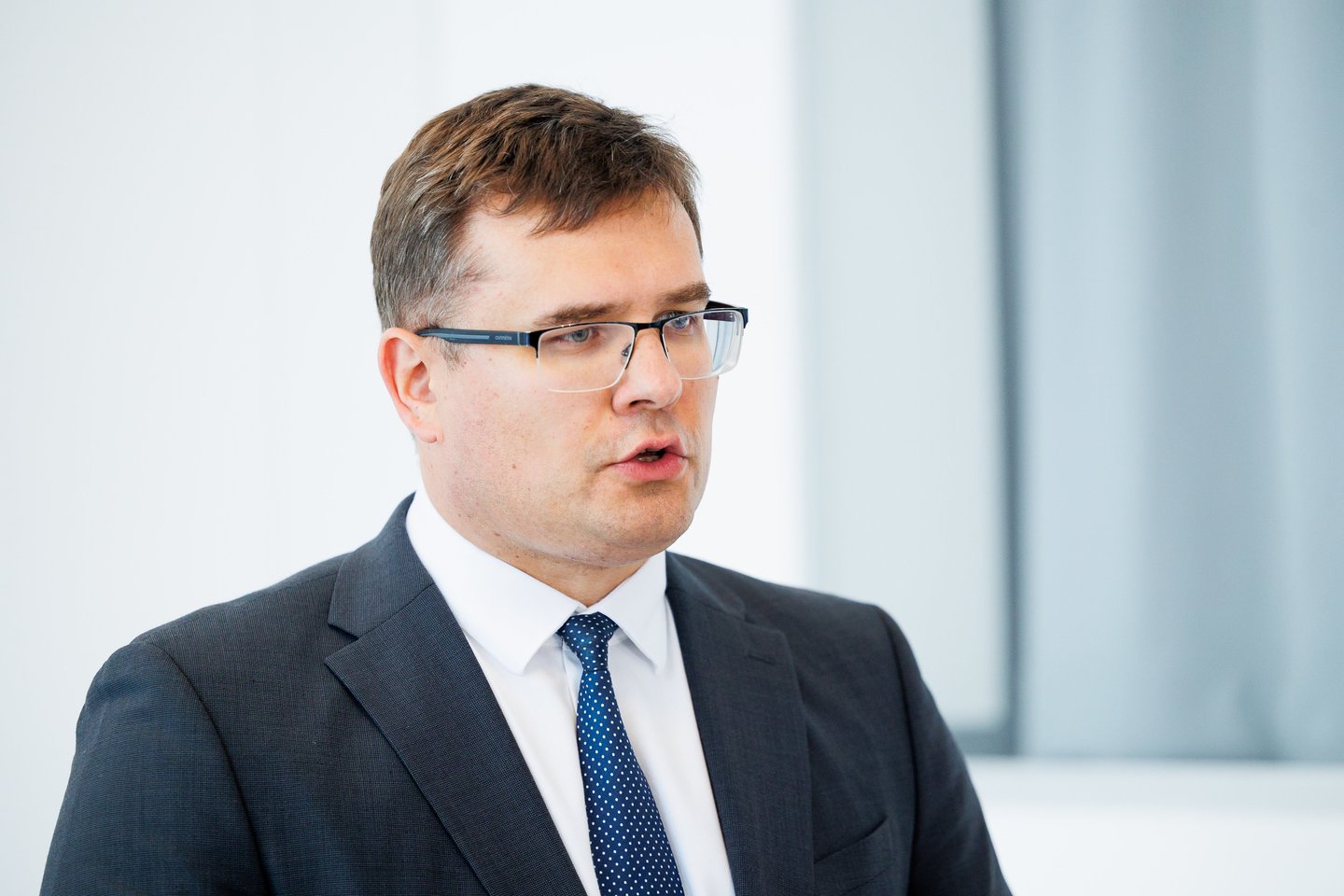
He made these remarks after LRT, citing its sources, reported that the Social Democratic Party’s council might discuss Budrys’s fate on Saturday, as the minister is allegedly working in a direction different from what the ruling coalition would like. The question of the coalition’s future also remains up in the air.
„I think Budrys is counting down his last days as minister. From what I’m hearing, decisions will likely be made this weekend. They could take various forms: there could be a reshuffle—that is, the formation of a new government—or it could simply be a reshuffling where you offer to have another party delegate ministers. (...)
Of course, it’s not that simple—if you try to reshuffle the system and renew the coalition, then there are new negotiations. Then the Seimas speaker, the prime minister, and all the other ministers are subjects of negotiation.
„If you’re going to replace the prime minister, then you have to think about what the esteemed Inga Ruginienė should be given. There are a lot of headaches,“ the lawmaker mused.
However, it may also be the case that there won’t be any major changes at all, says Kasčiūnas.
„Maybe we’ll wake up on Monday from this big cloud, and Žemaitaitis will be back in our coalition,“ the conservative mused.
Kasčiūnas claimed he had indeed heard behind the scenes that Sinkevičius could take Prime Minister Ruginienė’s place.
„A strong possibility. A growing one, I’d say. We probably realise this because the prime minister is apparently not at the peak of her performance right now. The Social Democrats need to think about what to do,“ he explained.
„There are so many scenarios that we could sort through and model here, but it will turn out however they decide, and I don’t even know who should decide. There are so many decision-makers within the Social Democrats that you can’t know—maybe they’ll really vote it down and leave things as they are,“ commented Kasčiūnas.
Čmilytė-Nielsen: he is the most vulnerable in the coalition
Viktorija Čmilytė-Nielsen, chair of the Liberal Movement, asserts that Minister Budrys lacks strong political backing, making him far more vulnerable.
„For some time now, I have been saying—and we have been saying—that Budrys’s position is the most vulnerable in this coalition because he lacks a strong political base. And his somewhat independent stance and firm, fairly distinct positions on foreign policy clearly clashed with the views of part of the coalition,“ Čmilytė-Nielsen told reporters at the Seimas.
The Liberal noted that if the Social Democrats decided to replace Budrys, it could worsen the party’s relations with President Gitanas Nausėda.
„If the Social Democrats decide to make no changes in the coalition, while Budrys’s position is growing increasingly weak. The president’s role is very interesting here because he is the president’s advisor, the president’s man. If a decision is made to remove Budrys from this government, it means that relations with the president will change irrevocably,“ she emphasised.
We remind you that recently, the foreign minister has faced criticism for his statements regarding Kaliningrad and his stance toward Belarus and China. Furthermore, it is unofficially speculated that Budrys does not always adequately represent the government’s foreign policy directions. There have reportedly been big differences of opinion between him and Prime Minister Ruginienė. For example, regarding the critical minerals agreement with the U.S., some Social Democrats were unhappy with Budrys’ trips to the regions and his meetings with representatives of party branches.
There was also discussion regarding the differing positions of the prime minister and Budrys on certain issues. The discussions arose after the prime minister, earlier this year, took the initiative to comment on certain foreign policy issues herself.
Ruginienė herself had previously asserted that the noticeably more active involvement of herself and LSDP Chairman Sinkevičius, the mayor of Jonava District, in foreign policy matters was not related to any alleged lack of trust in the head of Lithuanian diplomacy. The head of government stated that she trusts the Minister of Foreign Affairs.
For his part, Budrys said in mid-March that he did not feel any competition with the head of government. He claimed there were no divergent positions between them on foreign policy issues.
Meanwhile, President Nausėda said he views Lithuania’s foreign minister's work positively. According to him, the minister maintains a principled stance on issues important to the country, implements the government’s program, and follows the guidelines set for him by the president.