
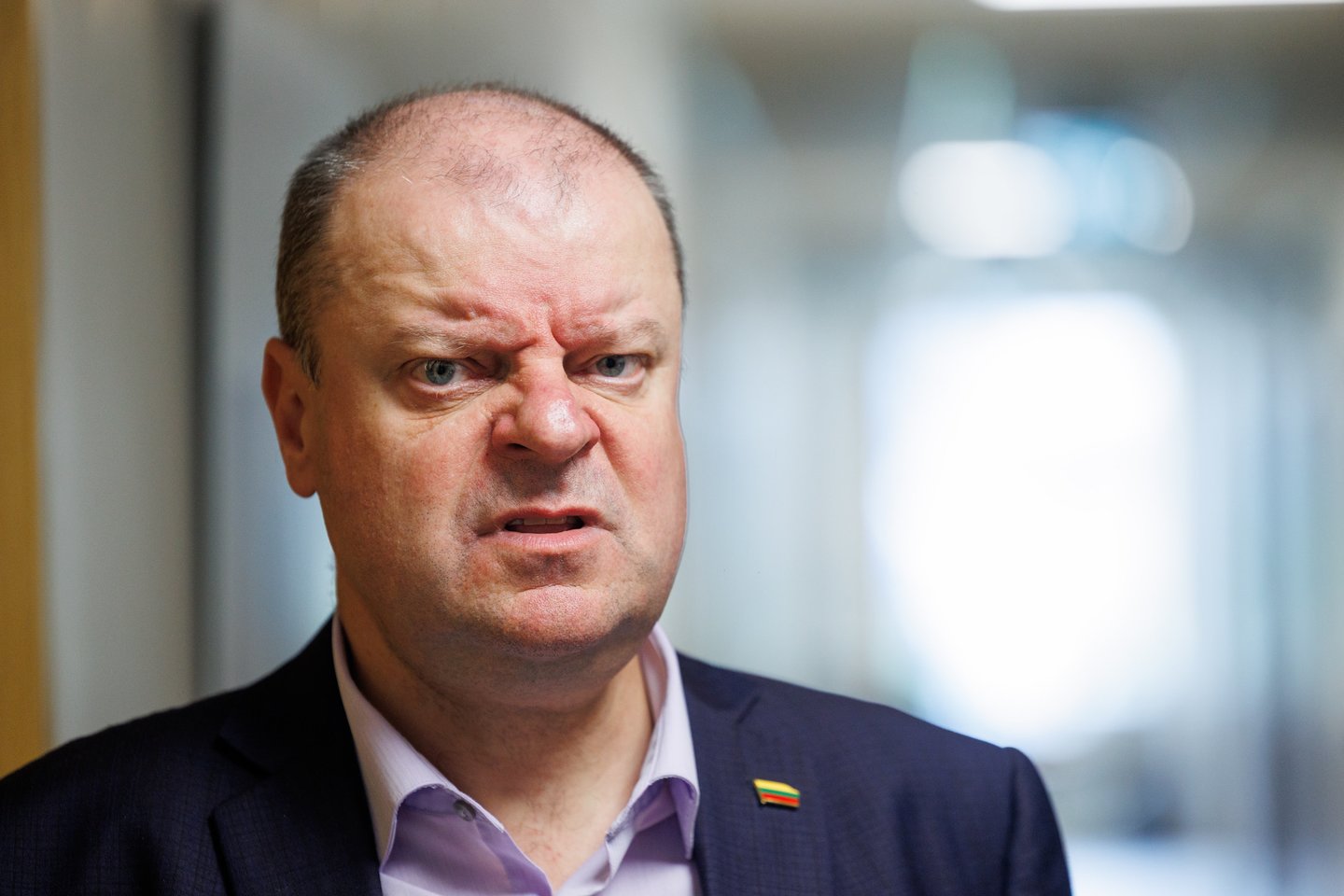
„I want to emphasise – I am not saying that this is a political case. It is a case that has taken on political aspects. And those aspects can be very clearly identified, and they will certainly be examined. However, we must not limit the discussion to the Lithuanian legal system here. At this stage, we are also preparing an application to the European Court of Human Rights. We will present those facts.
I can mention one example in this context. Just one for now, but there are others. These are the public statements made by the President of the Republic of Lithuania, which can unequivocally be regarded as a form of pressure on the public and the law enforcement agencies,“ the Member of the Seimas said in an interview with the Delfi news portal.
Mr Skvernelis drew attention to Mr Nausėda’s comments regarding the searches that had taken place and the information provided to him by officials.
„He went on to say that to bring charges against someone like me, one needs courage and civic-mindedness. But I believe that for anyone wishing to bring charges, what is needed is not courage and civic-mindedness, but evidence. And I’ll mention one more thing. This is probably the icing on the cake. He told one media outlet that he had been given operational information, which he had seen.
This is utter nonsense, because under no circumstances can any head of state – neither the president, nor the speaker of the Seimas, nor the prime minister – have access to criminal intelligence or so-called operational information. Not even in summary form. They have no such right,“ Skvernelis said in an interview with Delfi.
She said that, before the case, his relationship with the president had been excellent.
The courts ordered the suspect, who is accused of bribery, to wear an electronic tag; at the end of July, the Kaunas Regional Court ruled that this preventive measure was lawful and justified.
The judge noted that the suspect, Skvernelis, had failed to comply with the less stringent pre-trial measure imposed on him; specifically, breaches were identified involving communication with another suspect in the case, Agnė Silickienė. Skvernelis insists that his communication with Silickienė was merely a matter of mutual support.
„In this case, two people are being dragged through the mud in the public arena: Skvernelis and Silickienė. They are being portrayed as the protagonists of a massive corruption scandal. These are two people who are under enormous emotional pressure. There really isn’t much of a support network to turn to. Perhaps it’s easier for me, as I have someone to talk to at work. But for the other person, it’s perhaps more difficult. Those meetings were based on emotional and personal grounds,“ Skvernelis said in an interview with Delfi.
Charges brought
ELTA reports that, as part of an investigation into possible corruption at the Plant Production Service, searches were carried out at Skvernelis home and office in February. In April, the MP was charged with bribery.
Last December, during an investigation into a particularly large-scale corruption case at the Plant Production Service, officials had detained a total of 13 people. The number of suspects subsequently increased.
According to law enforcement authorities, evidence gathered during the investigation revealed that representatives of companies transporting plants and plant products were systematically demanded and paid large bribes in exchange for phytosanitary certificates issued by the service to freight carriers.
Even at that stage, those named as suspects included the service’s director, Jurijus Kornijenko, who had been suspended from his duties; his deputy, Mantas Butas; adviser A. Silickienė, who had also worked with MP Skvernelis; Giedrius Urbelionis, head of the Alytus regional branch, and Dalia Šubonienė, acting head of the Kaunas regional branch.
During more than 100 searches, over EUR 1.3 million in cash and 8 kilograms of gold, worth around EUR 1 million, were seized; 11,000 packets of cigarettes, 14,000 litres of alcohol, cocaine and explosives were also found.
In February, searches were also carried out at the home and office of Conservative MP Kazys Starkevičius. He was subsequently charged; he resigned his seat in the Seimas and announced that he was suspending his membership of the Homeland Union – Lithuanian Christian Democrats party. He later admitted to the news portal 15min that he had accepted a bribe of up to EUR 20,000.