
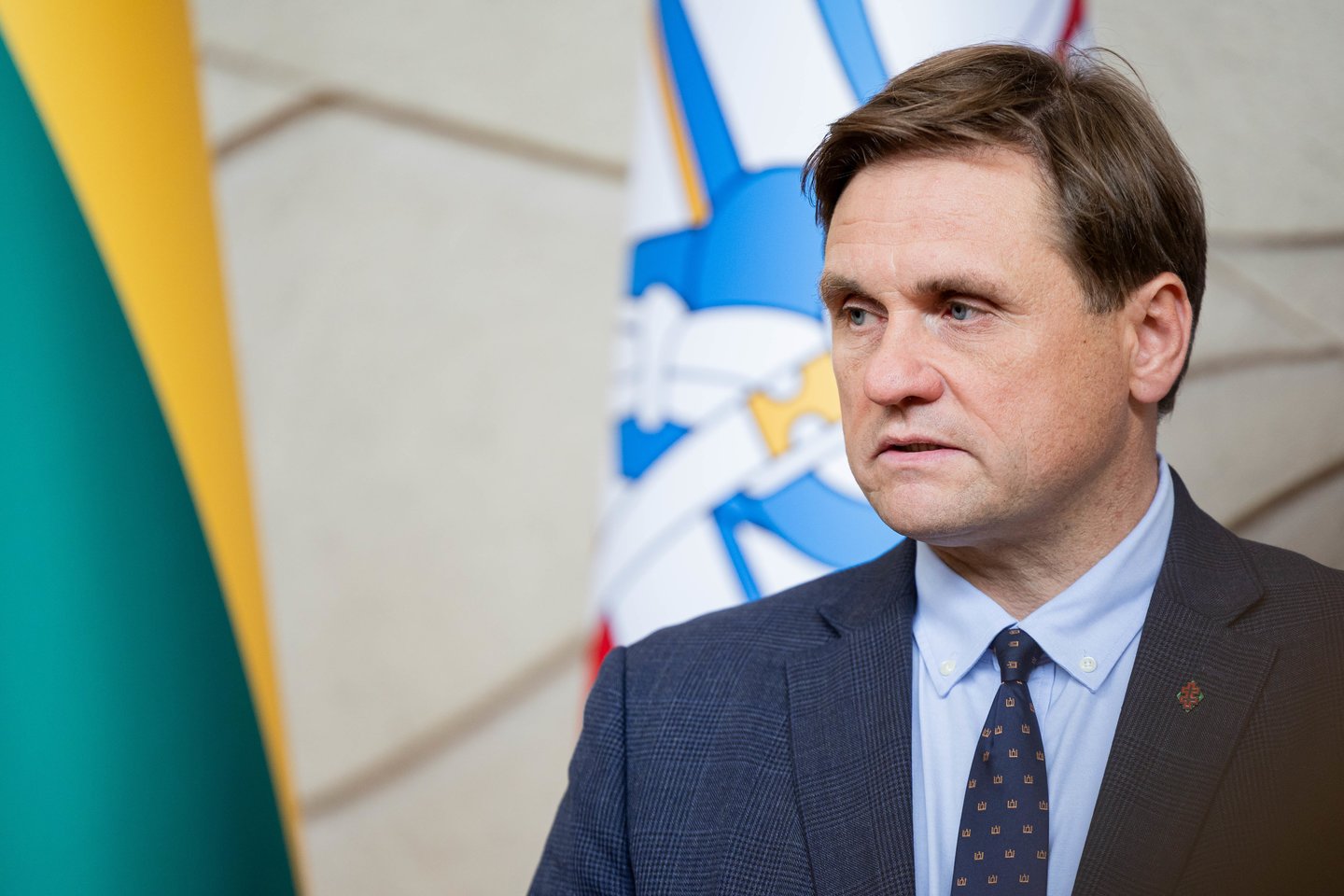
“There is an international evacuation aspect to this: what if we had to evacuate a certain number of people across the border, both from Lithuania and from neighbouring Latvia and Estonia? Border controls are usually put in place in such situations, when we are already facing a threat of war, as might occur during a military exercise scenario. Border controls are introduced to ensure mobilisation and to prevent people in certain key roles from leaving the country, so that they remain here to carry out their duties,” Vitkauskas told journalists at the Government on Friday.
According to him, in such a scenario, a large flow of people being evacuated could build up at the border; therefore, it is essential to assess in advance, together with our Polish colleagues, how such a situation would be managed.
“Consequently, a large flow of people would build up at the border. We must then, together with our Polish colleagues, very clearly assess all the procedures, and this is the main task. There is a large delegation – around 20 people from various institutions in Poland. We will examine all procedural shortcomings, document them, and then draw up a plan that will be prepared jointly, following an agreement between the two countries,” said the head of the NKVC.
“We have an internal plan, and an international one is currently being drawn up,” added Vitkauskas.
Susiję straipsniai


According to him, when drawing up the plan, it is also necessary to assess transport flows, transport links and the condition of the infrastructure. Vitkauskas said it is important to plan how the flows of people leaving and arriving will be organised, as well as to assess the need for bridge reinforcement and other infrastructure requirements.
“We need to assess the procedures; we need input from our colleagues in Poland so that they, too, can assess the shortcomings there, as we are talking here about logistics, transport links, road capacity and traffic flows. We need to organise one-way traffic for departures and arrivals; there are infrastructure issues with reinforcing bridges. Many technical details need to be assessed, documented and then addressed through infrastructure development and the investments that will also be required,” he said.
According to Vitkauskas, the Suwałki Corridor is particularly significant in this process, being important from both a military and a logistical perspective.
“The Suwałki Corridor is particularly important – both militarily and logistically. The involvement of our Polish colleagues is therefore very important, and we are extremely grateful to them for their participation and the high level of interest they have shown. (...) Poland’s participation takes us to the next level,” said the director of the NKVC.
Lithuania’s largest annual mobilisation exercise
The week-long Vyčio Skliautas exercise, the largest test of the national mobilisation system, begins in Lithuania on Friday.
Now in their third year, the exercises will involve around 3,000 civil servants, officials and representatives from local authorities, other institutions, businesses and non-governmental organisations, as well as around 1,000 volunteers.
The exercise will test how the state would function in the event of a deterioration in the security situation, disruptions to energy and communications systems, the organisation of civilian evacuations, the reception of allied forces, and the safeguarding of critical services.
The exercise will also assess how state institutions would transition to a mobilisation mode of operation.
The exercise, taking place from 25 September to 3 October, is Lithuania's largest annual exercise of its kind.
It will simulate the evacuation of civilians from municipalities bordering Belarus
ELTA notes that other civil defence exercises will also take place from 26 September to 3 October. These will simulate the evacuation of residents of Vilnius and other municipalities bordering Belarus in the event of a hypothetical threat of military intervention from Minsk.
The Cabinet of Ministers, meeting on Wednesday, approved a proposal to use stocks of medical and civil defence supplies from the state reserve during these exercises.
As stated in the draft government resolution, the main aim of the exercises is to improve the state’s preparedness to evacuate residents from the districts of Ignalina, Švenčionys, Vilkaviškis and Tauragė, and the municipalities of Kazlų Rūda and Pagėgiai to the municipalities of the Kaunas, Pakruojis and Telšiai districts.
It is reported that, during the exercise, residents will evacuate through the territories of the Šilutė, Šilalė, Vilnius, Elektrėnai, Kaišiadorys, Kelmė, and Šiauliai districts and the municipality of Kaunas City.